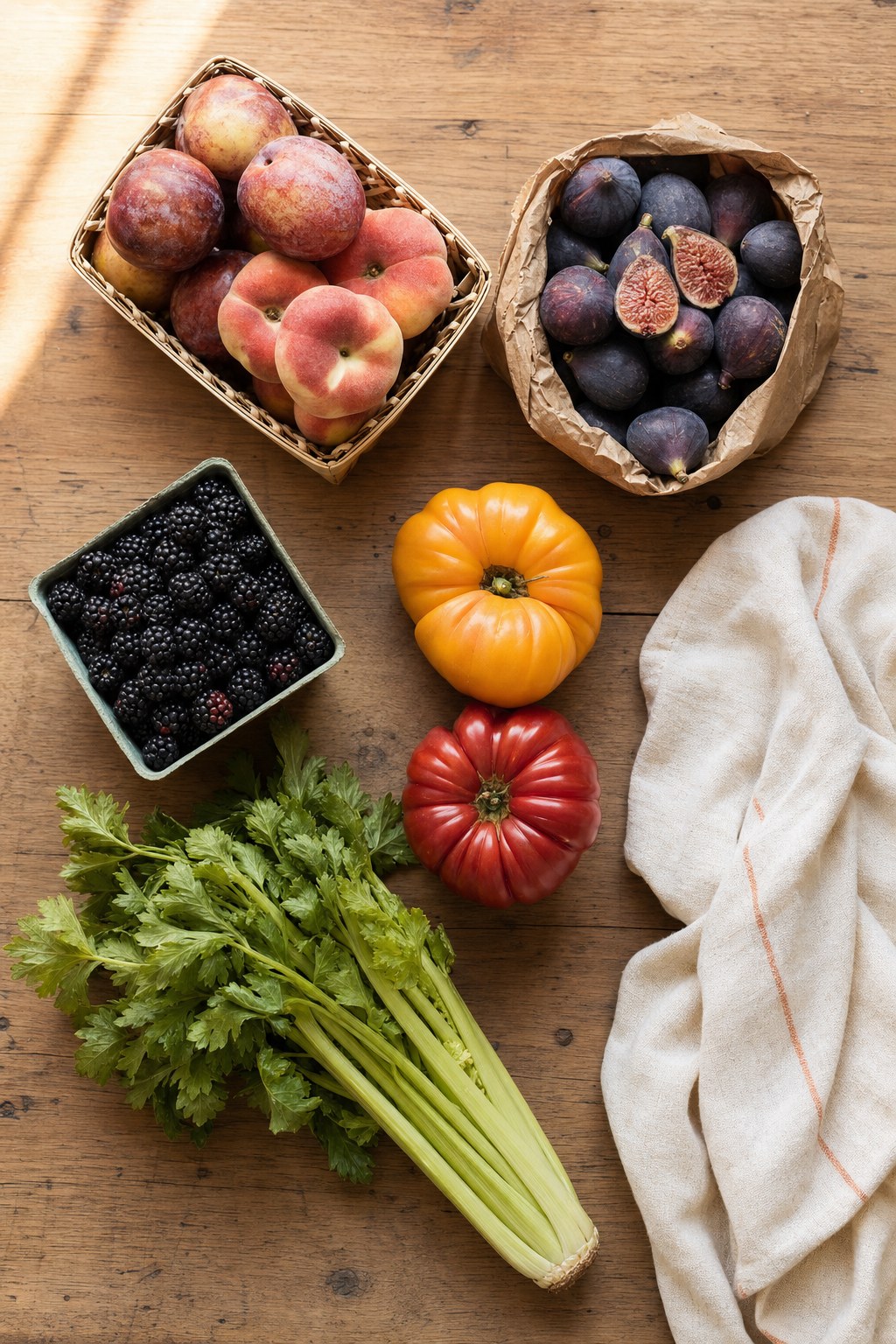
The cookbook has a chapter on how we grocery shop for a week of Tasty but Whole™ meals. Two stops: Costco for the bulk protein and pantry backbone, and a weekly fresh run for whatever vegetables look good and are in season. That framework is the whole point. What it can't do, printed and closed on the day the book ships, is tell you what's actually good on the actual weekend you're standing at the market. That's what Notes is for.
So here's this week's version. August 6, 2026. The tail end of high summer — and depending on where you live, "the tail end" means something a little different, so we'll be honest about that as we go.
Before we start: yes, we put a peach on the cover of the cookbook. It's the fruit of the summer table, the color of a good sunset, and the softest possible symbol for the way we want food to feel — generous, unfussy, alive. We love a peach. We also happen to know that a peach is only the peach for about two weeks in your specific climate, and this may or may not be one of those weeks where you live. Consider this a Note from the people whose brand mark is a peach, helping you figure out whether your peach week is right now, already gone, or still coming — and what else to reach for either way.
Three we'd carry home this weekend — almost anywhere in the US
These three are peaking coast to coast right now, regardless of what the local peach calendar is doing. Start here, then read the peach map below for your specific state.
Pluots. The pluot is a plum-apricot cross whose skin looks tie-dyed and whose flesh runs pink to garnet depending on the variety. Plums are in season across the US from July through October, and pluots ride the middle of that window in early to mid-August almost everywhere they're grown. Buy a small crate. Eat them out of hand over the sink for two days, because a ripe pluot has one outcome and it will not be negotiated with. Slice the last four into a bowl with Greek yogurt, a pinch of flaky salt, and a drizzle of olive oil. That's dinner if you want it to be.
Figs. Fresh figs ship from US growers June through mid-October, and August catches the second wave — the summer flush that tastes different from June's first crop, more honey and less green. If you skipped figs earlier this summer, this is your reprieve. If you don't see them at your market, most grocery stores stock them this month. We eat them halved with prosciutto and a torn ball of mozzarella when the tomatoes go on strike, and we roast them briefly in the same pan we just pulled chicken out of for a sauce that shouldn't work but does.
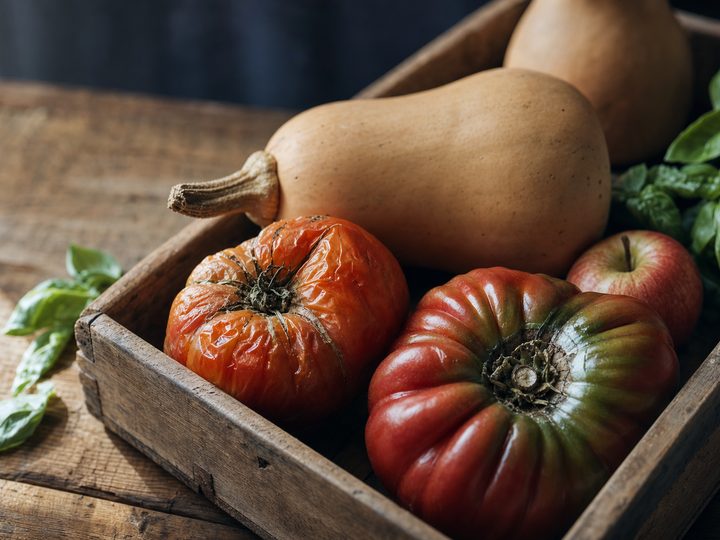
Heirloom tomatoes. CSPI's August guide lists tomatoes as still "in season" and that verb is doing too much work. Tomatoes right now are at the absolute apex of their year in every state that grows them — a two-week window where a plain slice on toasted bread with olive oil, salt, and a torn basil leaf is objectively better than anything you cooked last week. Buy them at the farmers market, not the grocery store. Grocery store tomatoes in August are grocery store tomatoes in April, which is a crime against the calendar. If the tomatoes you're picking up don't smell like tomato when you hold them near your face, you have the wrong tomatoes. A real tomato announces itself. So does a good peach. So does, generally, anything worth putting near your face.
The peach farmers market map (where are you, and are you regular?)
Here's where "in season" gets regional, and where a national guide has to stop being lazy.
Peaches follow the sun north. USDA's harvest window data puts it roughly like this:
- Georgia, South Carolina: May 20 – August 31. The famous Southern peach is finishing its run right now. If you're in the Southeast, this weekend is the last honest peach weekend of your year — buy heavy, freeze what you can't eat.
- Mid-Atlantic, South, California: June 1 – September 30. You're mid-window. Local peaches are peaking or holding steady. Ask which variety just came in — freestone varieties dominate August.
- New York, Michigan, Idaho, New England: August 1 – September 30. You're at the start of your peach window. This is when yours get good. The cheap California peaches you've been ignoring at the grocery store all summer suddenly aren't the point anymore — the locals just arrived.
- Everywhere else: July 1 – September 30. You have a month left, minimum.
The lesson isn't "peaches are in season" — it's your peaches, in your state, on this calendar. Ask the farmer when their peak week is. Then eat accordingly.
How we think about it here. We shop the Bay Area farmers markets, so we're in the California mid-window: peaches are peaking now, but the specific varieties rotate week to week. Instacart's 2026 US order data shows donut peaches peaking Aug 11 and white peaches peaking Aug 13 — a useful national signal for anyone shopping supermarket peaches, since Instacart demand loosely tracks when the ripest fruit hits the aggregated national supply. So next Tuesday and Wednesday, you're likely to see the sweetest peach the grocery-store system produces all year. That's the peach we'll pick up.
Your calendar will be different. The framework is the same: know your state's window, ask which variety just landed, and time your obsession to the week, not just a week.
The one August vegetable everyone ignores
Celery.
We're serious. August is the start of peak celery season, which runs through October, and nobody talks about it because celery has spent forty years being the crudité vehicle for someone else's dip. Celery has a PR problem. It is also, and we mean this sincerely, an aggressively effective piece of dietary fiber. If you have been eating like a college freshman, one week of good celery will fix things you did not know were broken. Grocery-store celery is a texture crop, not a flavor crop. But farmers market celery in August — anywhere in the country where the local growers pull it in — is a different plant: pale green, more delicate, dense with a specific herbal-sweet flavor that shows up in three dishes that improve immediately if you use it. A proper mirepoix for the soups we start making in six weeks. A chopped salad with feta and lemon. The raw crunch layer in a sheet pan chicken bowl.
We keep celery in the "wildcard" slot of our weekly shopping template. This is the week that slot pays off. Bring home the whole thing. The whole thing was the joke, in case you missed it. Save the leaves — they're the best part.
What to prep for
Hatch chile peppers hit US markets in mid-August. If you cook Hatch chiles once a year — the roast, the peel, the freezer bag that gets you through November — this is the seven-day window to plan for, wherever you shop. Most large grocery chains (Whole Foods, Central Market, Kroger regions, Costco in some markets) stock them for about two weeks in mid-to-late August, and then they're gone until next year. It's worth putting the calendar reminder in now. Adam ordered a pound last year, roasted them under the broiler on a sheet pan, and made an obscene amount of green chile sauce that lasted us into Thanksgiving.
Fall's opening act. Depending on where you are, pears start their harvest in August (Mid-Atlantic and Northwest) or September (most of the US). Apples begin to show up at Northern markets. Watermelon has one more strong month before it fades. If you're in a hot climate, don't be surprised when the trickle of fall crops starts arriving alongside peak summer — August is the crossover month.
The heuristic that actually works
We use a version of a rule we picked up from years of walking farmers markets: if the market piles it high AND the smell hits you from three feet away, buy it. If it looks perfect but has no scent, keep walking.
That rule doesn't care what state you're in. Pretty produce with no aroma is either weeks-old storage fruit dressed up for the display, or it was picked too early. Nose beats eyes at the market. Squeeze less than you think you should. Ask the person behind the table what came in this morning.
And here's the thing the cookbook already says but bears repeating: let the season tell you what to cook. We wander the market, we buy whatever looks beautiful, and we figure out how to cook it when we get home. Some of the best meals in the book started as a farmer handing us something we hadn't planned to buy. The two-stop grocery framework in the cookbook is the backbone of your week; the Saturday market — whether it's in the Bay Area, Brooklyn, Ann Arbor, or Austin — is the paragraph that makes it worth reading twice.
We'll do this again a few times through the fall. The whole point of a Notes section is that a chapter in a book can tell you how we shop, but only the week we're actually living in can tell you what to buy.
— Adam & Kiana