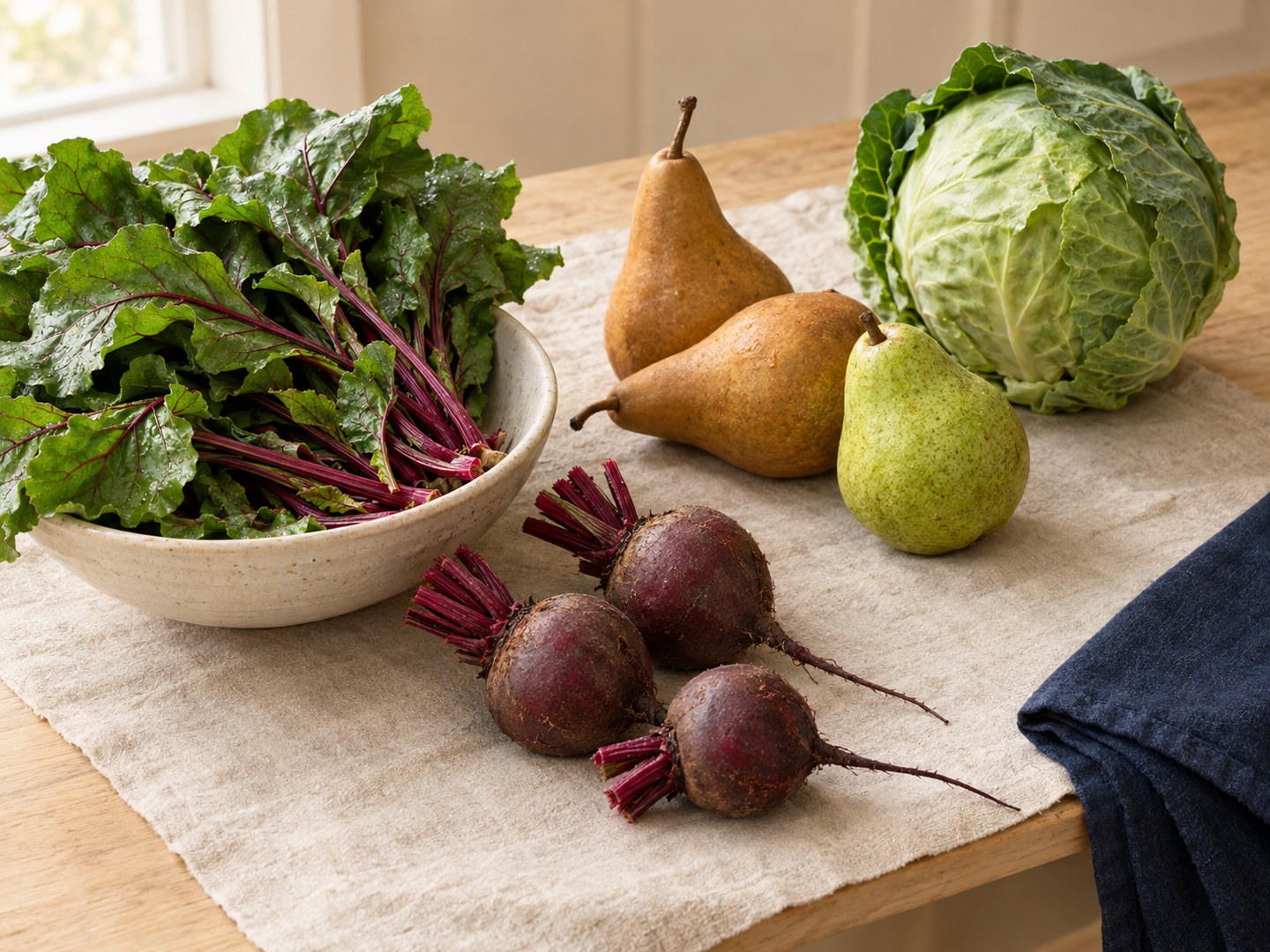
The October produce problem is not a shortage of things to buy. It is bringing home a beautiful bag, putting everything in the same drawer, and discovering on Thursday that the leaves had a different plan.
At Tasty but Whole™, we think a seasonal shopping list should come with an order of operations. Not a Sunday afternoon of identical containers. Just an answer to a useful question: what needs eating first?
September's Note covered the handoff from summer to fall. This month, leave the last-tomato countdown there. Build a smaller bag around beets with good tops, a whole cabbage, and a few pears. Then treat those ingredients as three different clocks. The greens go early. The fruit gets checked. The sturdy stuff can wait.
That is the October 2026 brief: buy a little less ambition, and give what you buy somewhere to go.
First, check whose October you are shopping
The same calendar page does not put the same crops in everybody's field. These are typical seasonal windows, not a report of what a particular farm harvested this morning.
Penn State Extension's harvest calendar includes October for beets, cabbage, and pears. It is a useful regional starting point from a Pennsylvania institution, not permission to call all three freshly harvested everywhere. In the Northwest, Oregon State's Food Hero guide lists Oregon-grown cabbage at local markets from July through October. Minnesota Extension describes a fall cabbage crop that generally needs harvesting by late October in most of that state.
Florida gives the comparison some teeth. Its agriculture department's typical harvest calendar lists cabbage from December through May, while cucumbers have an October-through-December window. And UF/IFAS's September 2026 planting guidance puts the target for planting cool-season vegetables in Central Florida around October 15. Planting is not harvesting, however encouraging the seed packet looks.
So use this bag as a framework, not a demand. Ask what was grown nearby, what was recently picked, and what is coming from storage or another region. A supermarket cabbage from elsewhere can still make an excellent dinner. Just do not ask it to impersonate a local harvest.
The first night belongs to the tops
The overlooked October ingredient is attached to another ingredient.
If you find beets with crisp, healthy greens, you are buying roots and a leafy vegetable together. University of Maine Cooperative Extension recommends choosing greens that are not wilted or slimy, separating them from the roots, and using the refrigerated greens within two or three days. The same guidance allows up to three weeks for the unwashed roots in a perforated bag in the refrigerator. Those are very different deadlines for things that arrived holding hands.
When unpacking, cut off the tops, leaving a short length of stem on the roots rather than cutting into the beet itself. Maine advises at least half an inch. Refrigerate the roots and greens separately, and wash the greens thoroughly before cooking. Let their condition, not just the shopping date, determine how quickly you use them.
For a first-night dinner idea, soften garlic in olive oil, add the washed, chopped greens, and cook until tender. Finish with lemon. Put them beside eggs, fold them into beans, or serve them with whatever protein was already happening. This is a cooking suggestion, not a new recipe that requires six supporting purchases.
The roots do not need cooking at the same time. Roast them later, or cook them for a salad when you actually want the salad. Buying the whole thing does not mean processing the whole thing in one sitting. Keep the tops moving.
If the greens are already tired at the store, choose good loose beets instead. Paying for unusable leaves is not a waste-reduction strategy.
Let the pears tell you when
A pear is not a dependable appointment. It is a small ongoing negotiation.
For European pears such as Bartlett, Bosc, and Anjou, use the stem end rather than color alone. Oregon State Extension advises gentle thumb pressure at the neck: a ripe pear yields a little. Most varieties do not show a dramatic color change. Bartlett is a notable exception.
Let pears intended for ripening sit at room temperature and check them daily. Once ripe, refrigerate them if you are not eating them straightaway; Oregon State gives up to five days in the refrigerator for a ripe pear. Timing varies with variety and prior storage. For fruit bought directly from a grower, ask whether it is ready to ripen at home, because some winter varieties need a cold-storage period first.
Do not apply the same softness test to an Asian pear. University of Wyoming Extension explains that Asian pears are sold ripe and should be refrigerated if not eaten immediately. Their crispness is the point, not evidence that you should keep waiting.
The practical move is to buy a few, not a bowlful. Slice a ready pear over yogurt, eat it with cheese, or add it to a cabbage salad when the timing lines up. Do not write “pear salad Thursday” in permanent ink and expect the fruit to respect management.
Give cabbage the later slot
A whole green or red cabbage is the useful counterweight to the leafy bunch. It gives the week something that does not demand first place.
There is a limit to that patience. Oregon State's Food Hero storage guidance says to refrigerate cabbage, use whole heads within two weeks, and wrap cut cabbage for use within two days. Use that as a conservative home-kitchen planning guide, not a guarantee regardless of freshness or handling.
This is a reason not to shred the entire head simply because the knife is already out. Keep it whole until you have a meal in mind. Once you cut it, plan the remaining portion promptly. A head chosen for later in the week should still be whole when later arrives.
Pick one direction. For dinner, cut wedges, brush with olive oil, season, and roast until the edges brown and the center is tender. Or slice it for a quick skillet meal. For crunch, make a small lemony slaw and add a ripe pear if one is ready. The useful part is having options without creating three half-finished side dishes.
Cabbage is allowed to be the backup plan. It does not need a personality makeover.
Unpack the bag into a plan
Here is a suggested order for a small household shop, adjusted to what is actually available where you are:
- Use first: Healthy beet greens, stored separately from the roots. Give them an early meal instead of burying them beneath the cabbage.
- Check daily: European pears ripening at room temperature. Move ripe fruit to the refrigerator and work it into the next snack or meal.
- Keep intact for later: Refrigerated beet roots and a whole cabbage. Delay unnecessary cutting; once the cabbage is cut, bring the rest forward in the plan.
- Skip the extra purchase: If there is already a vegetable waiting at home, finish that before buying a second backup. A bargain that needs rescuing is a demanding bargain.
This is not a full week's diet or a rule against convenience food. It is a way to fit seasonal vegetables and fruit around ordinary meals, ordinary schedules, and the evening when nobody wants a project.
If every item in the bag needs using tonight, the shop has assigned too much homework. If everything is sturdy but nothing sounds appealing, add one thing you genuinely want to eat soon. The pleasure matters as much as the plan.
October does not need another enormous haul. It needs a few good ingredients, an honest look at where they came from, and the right thing at the front of the fridge. First in line is not always the biggest thing in the bag.
— Adam & Kiana