The one that never got canceled
Adam has been taking AG1 since 2019, back when it was still just called Athletic Greens. In that time, a lot of supplements have come through our kitchen: things for performance, things for health, things that promised a lot and got quietly moved to the back of the cabinet. They rotate in and out.
AG1 is the one that never rotated out. It's the only supplement subscription in this house that has never been canceled.
That's a strange thing to admit in the first entry of Found Around the House, from a family whose whole brand is built on whole food. So here it is up front: this is a powder. It comes in a pouch. And it has earned its spot on the counter anyway.
Before anything else, the disclosure. Adam was an AG1 ambassador in 2025 and received a small amount of free product through the program. The program has ended, and we have no relationship with AG1 now: no affiliate link, no referral code in this note, no commission, and no stake in the company. Outside that small amount of free product during his time as an ambassador, Adam has paid for every pouch since 2019 himself.
What AG1 actually is
The current formula, AG1 Next Gen, is one 13-gram scoop a day. It contains 75 vitamins, minerals, probiotics, and plant-based ingredients (Fortune). The company reformulated it in May 2025, adding probiotics and vitamin K2 and removing green tea extract, among other changes (ConsumerLab).
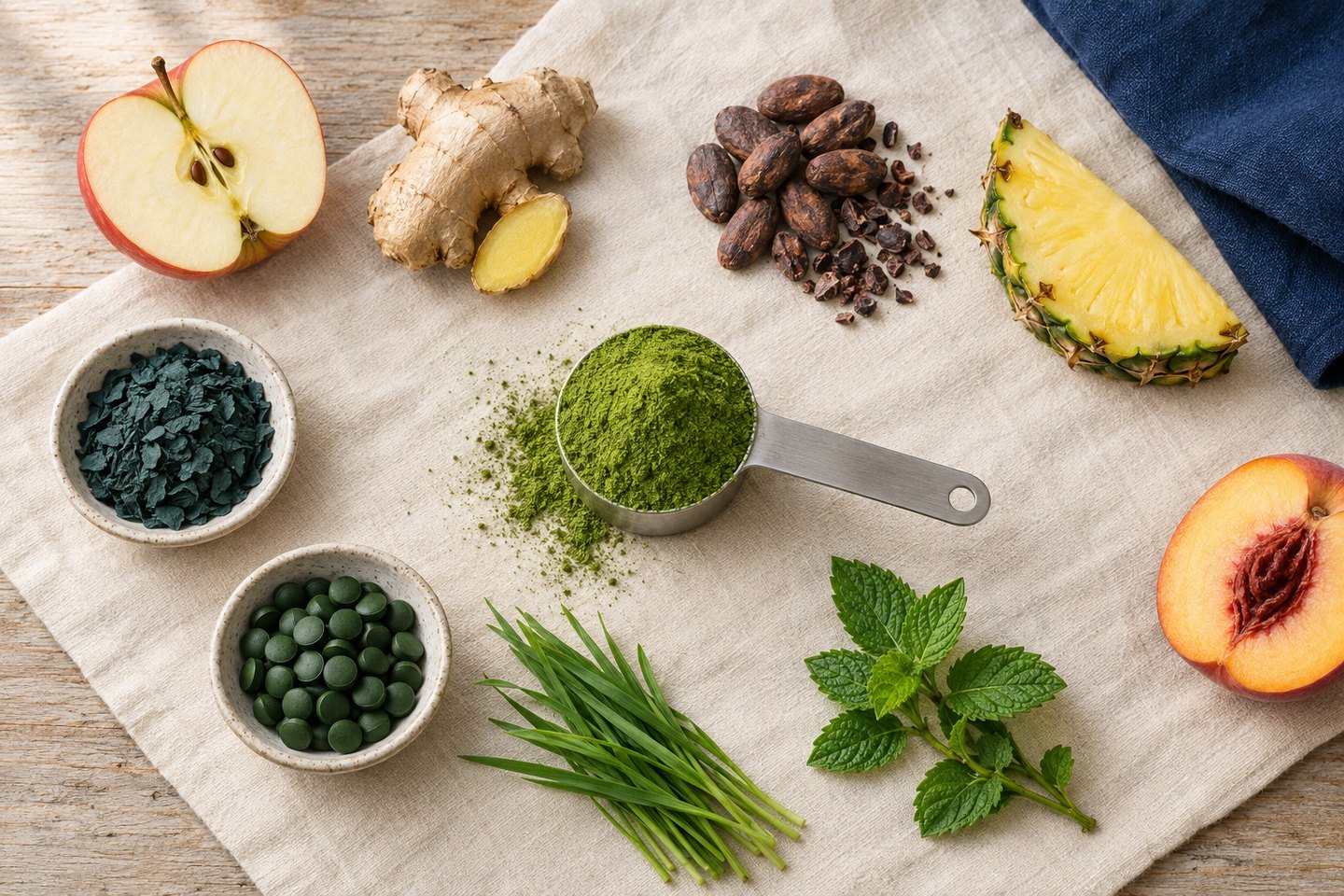
The label is worth reading closely. The biggest single line on it is the Active Superfood and Prebiotic Complex, at 7.5 grams of the 13-gram scoop: organic apple, spirulina, chlorella, ginger, cocoa, matcha, inulin, and a long list of herbs and extracts (AG1). So more than half of every scoop is the plant blend. It isn't all vegetables ground to dust. The same blend includes pea protein isolate, lecithin, and concentrated extracts. But the base of it is plants, and that's a big part of why Adam chose it over a standard multivitamin tablet.
Two more facts matter for trust. AG1 is NSF Certified for Sport, which means an independent lab tests it for contaminants and substances banned in sport (NSF). And the company funds its own research, which we'll get to.
How Adam takes it
It's the first thing he does every morning. Before coffee, before food, before training, before anything else.
He mixes it with more cold water than the pouch recommends, on purpose. After a night's sleep, the first glass of the day doubles as hydration. One scoop, a big glass, and the day has started.
The taste gets mixed reviews from other people. Adam likes it. It's roughly vanilla-pineapple, with a grassy note underneath from the spirulina and chlorella that some people can't get past. If you've never tried it, get the travel packs before you commit to a pouch.
Kiana doesn't take it. This is Adam's habit, not a household rule, and that seems like the right way to treat any supplement.
What happened when he stopped
In 2024, Adam stopped taking it for a few months. It wasn't a decision. His routine slipped, and the pouch sat unopened. He noticed a difference in his energy.
That's one person's experience, not a study, and we're not going to pretend otherwise. Energy moves for a lot of reasons, including sleep, stress, and everything else going on in a life. But it's also exactly how most people find out whether a supplement is doing anything for them: they stop, and something changes. Adam started back up, and the daily scoop has been doing its duty ever since. He's been regular about it, in every sense.
What the evidence says, honestly
This is where a recommendation note has to earn its keep.
AG1 says the Next Gen formula was tested in four placebo-controlled clinical trials, including a 12-week study of 105 healthy adults that looked at nutrient levels in the blood and changes in gut bacteria (AG1). One peer-reviewed trial found no negative effects on standard blood safety markers in healthy adults (Journal of the International Society of Sports Nutrition, 2025).
The fair criticism is that the company paid for this research, and ConsumerLab noted in July 2026 that only two of the four trials appear to have been published in peer-reviewed journals so far (ConsumerLab). ConsumerLab also flagged that the new formula raised vitamin B12 to 400 micrograms per serving, a very high dose, with some uncommon side effects associated with high-dose B12 (ConsumerLab).
The bigger point is one the NIH makes about multivitamins in general. In large studies of well-nourished adults, multivitamin and mineral supplements generally haven't been shown to reduce the risk of chronic disease (NIH Office of Dietary Supplements). A supplement fills gaps. It doesn't replace the plate.
That's how Adam uses it. In his words, it sets "a baseline of micronutrient support that perfectly complements the rest of my whole food diet." The vegetables still have to show up at dinner.
The price, and the cheaper option
The honest downside is the obvious one. AG1 is expensive: $99 for a one-time 30-serving pouch, or $79 a month on subscription, which works out to about $2.63 a serving (AG1).
This journal promises that when something cheaper does the job just as well, we'll say so. Here's the honest version. There are much cheaper greens powders, and a basic multivitamin costs a fraction of this. Adam has looked at them and keeps coming back, for the same reasons each time: the third-party testing, the ingredient quality, the research behind it, and the plant base. He'd rather spend a little more on something he trusts every morning than save money on something he's not sure about.
If your budget is tight, though, the cheaper option is real, and it isn't another powder. It's more vegetables, a simple multivitamin if your doctor thinks you need one, and blood work to find out what you're actually short on. More on that below.
A little AGZ
AG1 launched AGZ, a nighttime drink, on August 21, 2025, its first all-new product in 15 years (PR Newswire). Adam signed up as soon as it came out.
It contains no melatonin. The main ingredients are magnesium L-threonate, L-theanine, saffron, and ashwagandha, plus a blend of calming herbs that includes valerian, chamomile, and lemon balm (AG1). It's $79 for a 30-day subscription, or about $2.30 a serving on the 90-day plan (AG1).
He takes it every night. His sleep is better, and so is his recovery. He doesn't sleep as many hours as he probably should, but his sleep efficiency has been excellent.
The simplest way to put it is his: "AG1 supports my day and AGZ supports my night." Between the two, AGZ is his number two. If he had to give one up, it would be AGZ, but they're the two supplements he takes every day.
One real caution on AGZ: it contains ashwagandha. The NIH notes that ashwagandha appears well tolerated for up to about three months, that its long-term safety isn't known, that there are rare reports of liver problems, that it may affect thyroid function and interact with some medications, and that some experts advise against it during pregnancy (NIH Office of Dietary Supplements). If any of that applies to you, talk to your doctor first.
The rest of the shelf
A few more things from the same company live in Adam's routine, and each has a specific reason to be there.
AG1 Pro. In June 2026, AG1 launched Pro: the full Next Gen formula plus 5 grams of creatine monohydrate, calcium-HMB for muscle retention, and zinc carnosine for gut-lining support (PR Newswire). Adam switched about a month ago. So far the main difference is that he no longer takes creatine separately, which is one less scoop and one less tub. He's watching for changes in gut health and recovery, and it's too early to report any. Five grams a day is squarely in the range creatine research supports, and the International Society of Sports Nutrition considers creatine safe for healthy people over the long term (JISSN, 2017). Pro costs more: $99 a month on subscription (AG1).
Vitamin D3/K2 drops and Omega-3. These aren't here because they're trendy. They're here because Adam's blood work showed he was low in both. Worth knowing: the AG1 powder itself contains no vitamin D (AG1), so if you're low, a greens powder alone won't fix it. He buys the drops and the omega-3 from AG1 because he trusts the quality, and because it's easier to keep everything on one subscription.
Which brings us to the most useful thing in this note. Test, don't guess. A standard blood panel can show where you personally are short. Vitamin D, for example, is measured with a blood test for 25-hydroxyvitamin D, the main indicator of vitamin D status (NIH Office of Dietary Supplements). Ask your doctor what makes sense for you. Supplementing for a gap you've measured beats supplementing for a gap an ad told you about.
Who should skip it
Skip it if the price would strain your grocery budget. Better food comes first, every time.
Talk to your doctor first if you're pregnant or nursing, take prescription medication, or have a thyroid or liver condition, especially before trying AGZ.
Try it if you already eat reasonably well, want one reliable, well-tested baseline in the morning, and like the idea of starting the day with a big glass of water. Start with travel packs to find out whether you like the taste.
Where to find it:
- AG1 Next Gen, official site: the current formula, subscriptions, and travel packs
- AG1 on Amazon: check the listing to make sure it's the current Next Gen formula, since ConsumerLab reports the original formula is still sold through AG1's Amazon store
- AGZ, official site: also sold at Target (PR Newswire)
We pay for all of it ourselves, and none of these links earns us anything.
It isn't a whole food. It's a powder. But more than half of every scoop is plants, and it covers the gaps a good diet can leave. As Adam puts it: "It's tasty, and for the most part it's whole."
— Adam