The one that didn't go back on the shelf
In 2019, Adam was reading every nutrition book he could get his hands on. Most of them were about paleo, because that was the lane he was in. Ground beef and sweet potatoes, most nights, for a long time. It was regular in every sense.
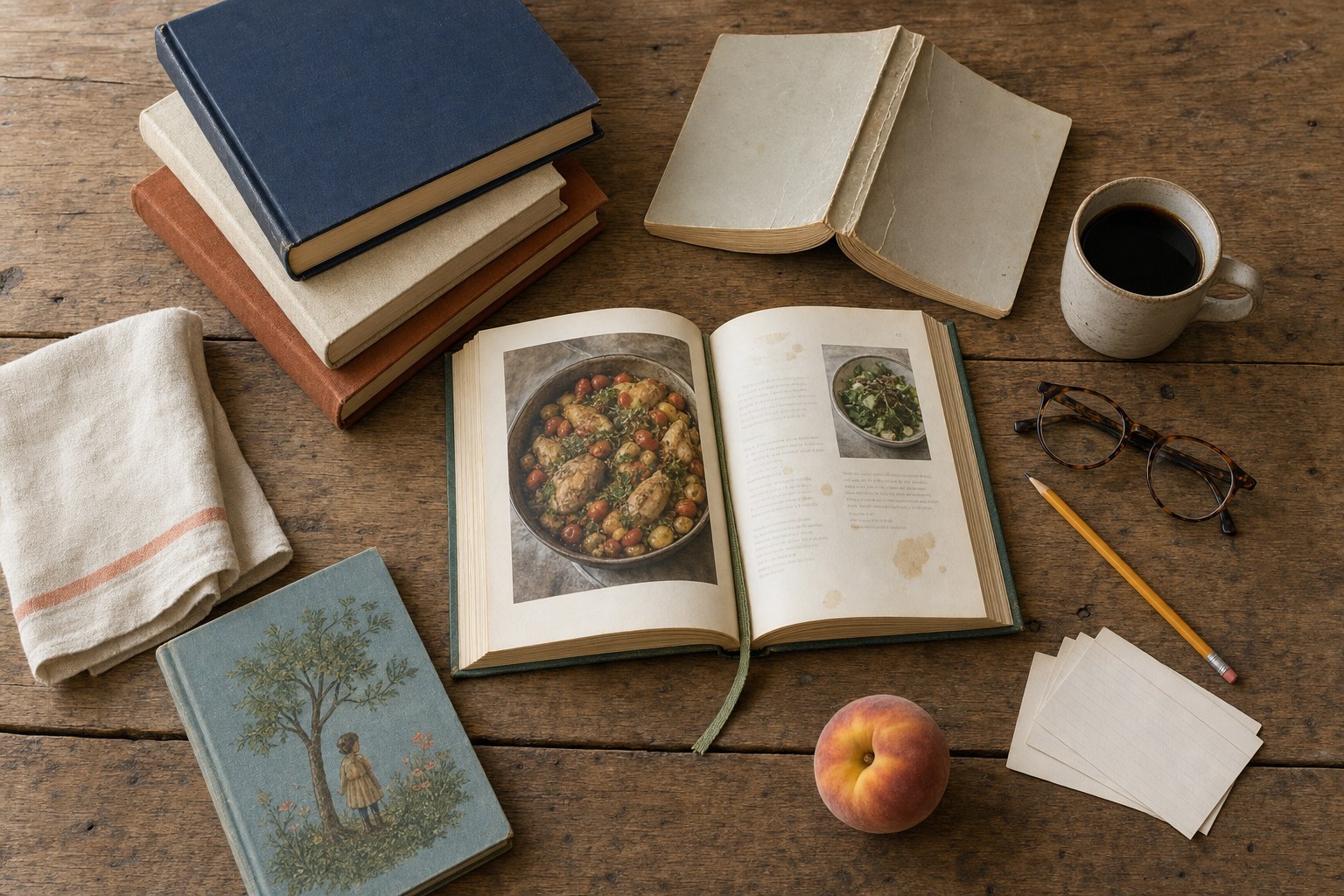
Deep Nutrition showed up as something adjacent. Not quite paleo, not quite anything he'd read before. He listened to it first, as an audiobook, and then bought the hardcover. Not to display it. To read it again, all the way through, and then to keep it within reach for reference. It has been read cover to cover more than once since, and it is still the book that quietly decides a lot of what goes in the pan in our house.
Most nutrition books get read once and then moved to the shelf. This one keeps getting pulled back down. That's why it's the first entry in From the Bookshelf.
What the book actually is
Deep Nutrition: Why Your Genes Need Traditional Food is by Catherine Shanahan, M.D., a physician with a background in biochemistry, written with Luke Shanahan (Macmillan). It was first self-published in 2008 (Amazon). A revised, expanded edition came out in January 2017, more than nine years later, with new chapters, more evidence behind its claims, and answers to the questions readers had sent in over the decade (5280). The author describes the new version as having roughly twice the content and three times the references (Dr. Cate). That's the only version Adam has ever read, since he found the book in 2019. If you buy one, buy that one.
The premise is simple to say and big to prove. Shanahan looked at traditional food cultures known for producing healthy people over long stretches of time, including the Mediterranean, Okinawa, and the "Blue Zone" diets, and asked what they had in common beyond geography (Macmillan). Her answer is what she calls the Human Diet.
What Adam liked from the start is that it isn't a list of banned foods. It's an argument about why certain ways of eating have lasted for thousands of years, and it gives you the history and the science behind what most grandparents would have called common sense.
The Four Pillars
The book boils those traditional diets down to four habits, which it calls the Four Pillars (Dr. Cate):
- Meat cooked on the bone. Bone-in cuts, slow cooking, and broth made from what's left. The whole animal gets used, not just the lean middle.
- Organ meats. Liver, heart, and the rest. Nutritionally, this is the book's heaviest hitter.
- Fermented and sprouted foods. Kimchi, sauerkraut, yogurt, and the other foods that cultures learned to preserve before refrigeration and kept eating after it.
- Fresh foods. Raw produce, fresh herbs, food that hasn't sat in a warehouse long enough to lose what made it worth eating.
None of these is exotic. That's the point. Every one of them was ordinary until very recently, and every one has mostly disappeared from the way a lot of people eat now.
Where it shows up in our kitchen
The fastest way to see what this book did to us is to open our cookbook.
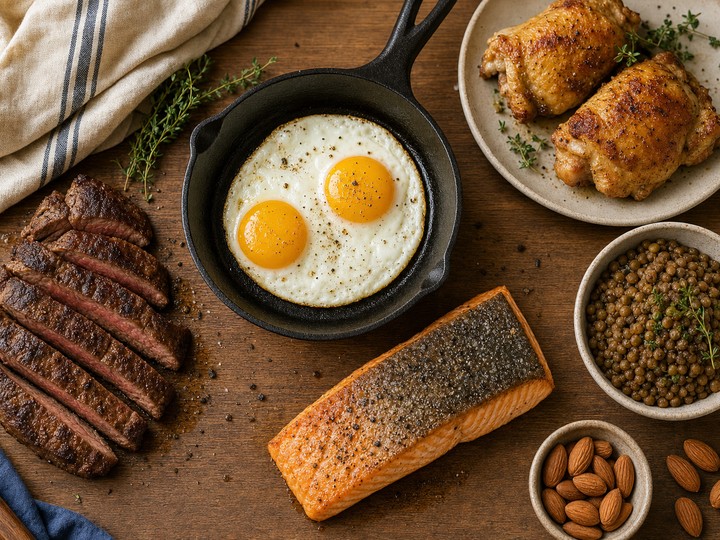
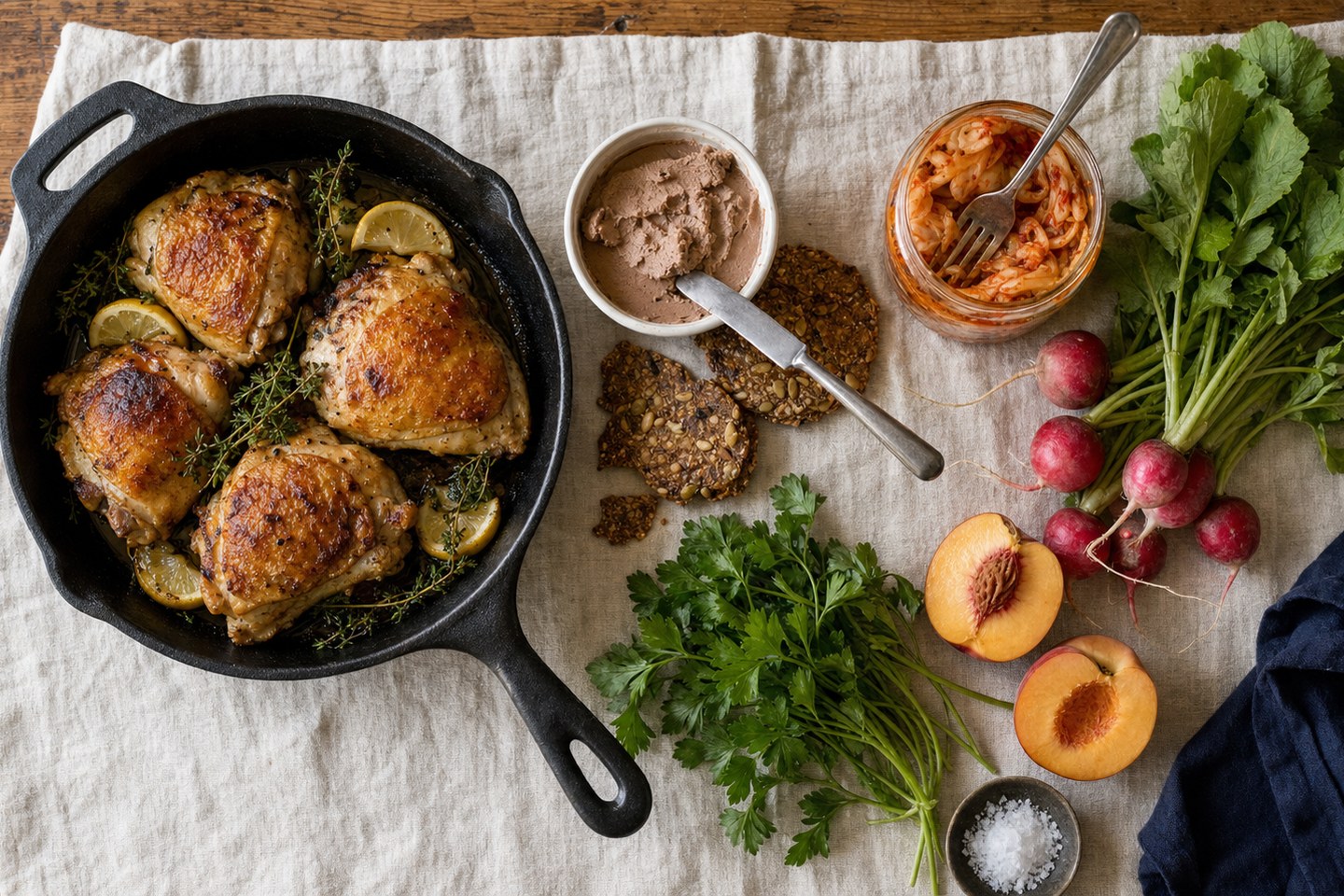
There isn't a drop of canola or "vegetable oil" in Tasty but Whole™. The fats are butter, olive oil, ghee, and avocado oil, chosen on purpose. Bone broth shows up again and again, because it turns a weeknight soup into something that tastes like it took all day. Bone-in, skin-on chicken thighs are our most-cooked protein. Kimchi goes into a grilled cheese. Liver shows up too, as Chicken Liver Pâté Crostini with Fig Jam, for the brave.
That's the book's spirit, adapted to a family with a toddler, a full calendar, and a dog who is extremely interested in anything cooked on the bone. It's the reason Adam found it easier to live with than strict paleo. Deep Nutrition keeps the core ideas, real food, good fats, and nothing overly processed, while leaving room to adjust. And eating that way simply felt good, which counts for more than any argument.
A jar of sauerkraut in the fridge door doesn't look like much. For a household, it is also a quiet regularity program. We'll leave it there.
Where we part ways
This is a recommendation, not a devotional, so here's the honest part.
It can be alarmist. Deep Nutrition puts a lot of weight on food as the explanation for a lot of things. Health is shaped by sleep, stress, movement, genetics, money, access, and luck, along with what's on the plate. Nutrition matters a great deal. It isn't the only thing that matters, and at times the book reads as if it were. Some readers and dietitians have criticized the book's evidence as uneven, a mix of research and anecdote, and its bigger claims as going further than the research supports (r/dietetics). We think that's a fair criticism of the book's tone even though we agree with most of what it recommends.
We like the spirit of the rules more than the rules. Take organ meat. Liver is one of the most nutrient-dense foods there is. Three ounces of pan-fried beef liver carries about 6,582 micrograms of vitamin A, roughly 731% of the daily value (NIH Office of Dietary Supplements). That same number is a reason to eat it deliberately rather than in quantity: the upper limit for preformed vitamin A in adults is 3,000 micrograms a day, including during pregnancy (NIH Office of Dietary Supplements). Eating it every week isn't realistic for most families, and forcing it down when you hate the taste isn't worth the stress. If you like liver, great. If you don't, the other three pillars still do a lot of work.
On seed oils, we agree, but not dogmatically. This is where the book takes its strongest stand, and where we agree with it most. Our cookbook doesn't use seed oils, and we mostly keep them out of our kitchen. But in fairness, much of mainstream cardiology disagrees with the book on this. An American Heart Association science advisory concluded that omega-6 fats, which seed oils are rich in, are linked to a lower risk of heart disease, not a higher one, at intakes of about 5–10% of calories (Circulation, 2009). The Harvard Heart Letter's position is that seed oils aren't inherently unhealthy and that it depends on how they're used and what they're in (Harvard Health, 2025). Where both sides land in practice isn't far apart: much of the seed oil people eat comes through fried and heavily processed food, and eating less of that is the one thing nearly everyone agrees on. We choose other fats. We won't lecture anyone at a restaurant about it.
The parts that hold up
For all our disagreements, the book's core instincts have aged well.
A home-cooked, minimally processed diet has good evidence behind it. In a 2019 NIH inpatient trial, 20 adults ate either ultra-processed or minimally processed meals, matched for calories, sugar, fat, fiber, and carbohydrates, and could eat as much as they liked. On the ultra-processed diet they ate about 500 more calories a day (NIH).
Fermented food looks better the more closely it's studied. In a 2021 Stanford study published in Cell, 36 adults added fermented foods to their diets for 10 weeks. Their gut-microbe diversity went up, and 19 inflammatory proteins in the blood went down (Stanford Medicine). That's one pillar backed by a modern randomized study, even if not every claim built on it is.
We don't need every claim in the book to be right. We need the thinking behind it to point in a good direction. Here it does.
Who should read it
Read it if you already eat reasonably well and want to understand why: the history and science behind real food, explained by someone who clearly loves the subject. It's the book we'd give someone who has done the basics and is ready to go deeper.
Skip it or go slowly if strict food rules tend to make you anxious. The book's tone can make ordinary meals feel like high-stakes decisions. Take the four pillars and leave the pressure.
Which edition: the 2017 revised edition from Flatiron Books. It's longer and better referenced than the original, and it's the one we've been reading from the start.
Where to find it:
- Deep Nutrition on Amazon: the 2017 revised hardcover
- The book's page on Dr. Cate's website: the author's own site, with more about the Human Diet
We bought our copy ourselves, and nobody paid us to recommend it. Neither link earns us anything.
It's a big book, so give it a whole afternoon, or a lot of shorter sessions in the smallest room of the house. Either way, you'll probably end up doing what Adam did: finishing it, then going back to the start.
Sign off, Adam & Kiana