The chips gave it away
Adam was in the grocery store a few weeks ago, standing in the aisle that gets called the "healthy" section, when he found protein potato chips. Fried. Ultra-processed. A protein claim stamped on the front like a badge of honor.
That's the tell. When a fad gets big enough, marketing finds a way to slap its buzzword on anything — including the exact category of food the buzzword was supposed to help you avoid. Protein didn't do that to itself. We did, collectively, by turning a nutrient into a leaderboard.
This isn't an anti-protein piece. Protein is good. You need it, and most people reading this are trying to eat well, move more, and take care of themselves — which is exactly the audience getting the worst advice right now. Between the strength-training boom and a wave of GLP-1 medications making rapid weight loss more common than ever, protein has become the one macro everyone's told to maximize. Bars. Powders. Chips, apparently. The instruction is always the same: more is better, track it, hit the number.
We think that instruction is wrong, or at least incomplete enough to cause real problems. Here's the actual case, the honest caveats, and what we do instead.
What protein actually is — and why "enough" is a real, satisfiable number
Start with the part almost no one explains: protein isn't really the nutrient you need. Amino acids are. Protein is just the delivery vehicle — a chain of amino acids your body breaks down and reassembles into muscle, enzymes, hormones, and a few hundred other things you'd notice the absence of pretty quickly.
That distinction matters because amino acids behave like a threshold nutrient, not an open-ended one. You need a specific amount, in a specific mix, to cover what your body is actually building and repairing. Once you've covered that, extra amino acids don't sit around waiting to be useful later. They get broken down, the nitrogen gets stripped out and excreted as urea, and what's left gets burned for energy or stored — the exact same fate as extra carbohydrate or fat calories once your energy needs are met (dotFIT). Past your threshold, protein isn't a special macro anymore. It's just calories wearing a health halo.
This is closer to how we already think about a vitamin than how we think about a macro people "bulk up" on. Nobody takes ten times their vitamin C target hoping for a bonus. You hit the requirement, you're covered, you stop thinking about it. Fiber works the same way — a real, satisfiable target, not a "more is always better" dial. Fiber has the added bonus of letting you know, personally and promptly, when you've overshot it. Protein just lets you find out later, from a lab result. Protein deserves the same threshold-not-dial treatment, and mainstream nutrition science is quietly catching up to that idea.
So what's the actual number? It depends on who's asking, and this is the one place we won't pretend a single figure fits everyone:
- The official U.S. RDA is 0.8 grams per kilogram of body weight per day — but that figure was set to prevent deficiency in a sedentary population, not to define an optimal target. A more rigorous statistical re-analysis of the same data puts the real minimum closer to 1.0 g/kg/day, and newer measurement methods suggest a practical floor closer to 1.2 g/kg/day for most healthy adults (Examine.com).
- If you're training seriously and trying to build or maintain muscle, that number goes up. Sports-medicine and dietetics organizations put the athletic range at roughly 1.2–2.2 g/kg/day, depending on the goal and the person (Examine.com).
- Adam's own target sits inside that range, but calculated off lean body mass rather than total bodyweight: roughly 1 gram per kilogram of lean mass on the low end, up to about 1 gram per pound of lean mass on the high end. That's an anecdote, not a universal prescription — it works for someone actively trying to maintain and build muscle, calculated off the tissue that's actually doing the building. If your goals or your training load are different, your number is too.
The point isn't the exact figure. It's that there is a number, it's reachable through food, and clearing it is the whole job. Nothing good happens on the other side of it that wasn't already covered.
What happens when you go past it
This is the part the marketing conveniently leaves out, and it's worth being precise rather than alarmist about it.
Evidence-based: A major 2026 review of more than 350 studies on protein and amino acid restriction found that lower protein intake — even without cutting total calories — was linked to better metabolic function, reduced inflammation, less cellular damage, and the activation of biological pathways associated with healthier aging (Knopf & Lamming, Cell Press Blue, 2026). Part of the mechanism involves a hormone called FGF21, which rises when protein intake drops and appears to improve blood sugar regulation and extend lifespan in animal studies. The review also singled out three amino acids in particular — methionine, isoleucine, and valine — as playing an outsized role: chronically excessive intake of these may keep certain growth-signaling pathways switched on longer than they should be, which over time is associated with a higher risk of obesity and inflammation.
Separately, high-protein diets have a real, measurable effect on the kidneys. Diets where protein makes up roughly a quarter of calories have been shown to raise a marker of kidney filtration stress within six weeks compared to lower-protein diets, and longer population studies have linked higher protein intake to declining kidney function over a decade, in people with and without pre-existing kidney disease (Journal of the American Society of Nephrology, 2020). None of this means protein is dangerous. It means "more protein" is not a free action, and the marketing wants you to believe it is because a threshold nutrient makes a terrible product story. A leaderboard sells more units than a box you check once and move on from.
The honest caveat, stated plainly: none of this is a case for eating less protein if you're training hard, aging, or actively rebuilding muscle. The same review that raised these concerns was explicit that protein's benefit for muscle growth and exercise recovery in active people is unambiguous, and that athletes routinely eat large amounts of protein without developing metabolic problems — most likely because training itself redirects that surplus into muscle tissue instead of leaving it to cause the problems above. The concern is squarely about sedentary or moderately active people eating far past their real need because a bar or a shake made it effortless. This isn't a piece telling a marathoner or a 70-year-old rebuilding strength to cut back. It's a piece telling the person who added a protein shake on top of an already-adequate diet, purely because the packaging told them to, that the shake isn't doing what they think it's doing.
Lived experience: Adam spent years tracking protein grams during obstacle-course-race training, and the honest report is that it made eating worse, not better. Hitting a number by 9pm sometimes meant a protein bar or a scoop of powder he didn't actually want, just to close the gap — food chosen for a spreadsheet, not for hunger or enjoyment. The irony is that tracking a "healthy" macro pushed him toward more processed food, not less. (Good protein powder, used well, is fine — that's not the complaint. The complaint is eating it when you're not hungry because a number told you to.)
Quality is the part everyone skips
Here's the correction to the correction: even the "eat whole-food protein instead of processed protein" advice usually stops one step too early, because it still treats a gram of protein as a gram of protein. It isn't.
What actually matters is how much of what you eat your body can use — sometimes described as protein quality, and it comes down to two things: the amino acid profile (does the food contain all the essential amino acids, in roughly the ratio your body needs) and digestibility (how much of it survives digestion in a usable form). The current gold-standard measurement, called DIAAS, scores a protein source against its single most limiting essential amino acid, using digestibility measured at the end of the small intestine rather than a cruder whole-gut estimate (Examine.com). One particular amino acid, leucine, does outsized work here — it's the specific trigger that switches on muscle protein synthesis, so a food's leucine content matters more than its raw gram count.
That reframes the right question. It's not "which food has the most protein per calorie." It's closer to protein-per-calorie multiplied by a quality factor — how complete the amino acid profile is and how much of it your body can actually put to work, rather than how much passes through unused. Whole animal proteins — eggs, chicken, beef — tend to score well on both counts: complete amino acid profiles, high digestibility, no assembly required. That's not a brand endorsement. It's the mechanism working the way it's supposed to when you eat food instead of a food-shaped product engineered to hit a single number on a label.
This is also why the protein chips were such a perfect example of the whole problem. They can print an impressive gram count on the front and still be a mediocre source once you account for quality and absorbability — on top of everything else that comes with frying a processed food in industrial oil. The label told the truth about one number and nothing about the food.
A concrete comparison makes this real, and it has to be a comparison where quality actually changes the answer, not confirms it. Take an egg against a typical protein bar. A large egg runs a DIAAS around 113 — meaning, roughly, that its usable amino acid content clears 100% of what your body needs from that gram of protein, and then some (Frontiers in Nutrition, 2023; ADPI Protein Quality Guide, 2025). Whole beef and chicken land in almost the same neighborhood, usually somewhere in the 100-110 range. A protein bar, on the other hand, is only as good as whatever protein source got blended into it, and cheap bars lean on cheap sources: rice protein scores somewhere around 40-60, wheat protein even lower. Even a bar built on a genuinely good plant protein like soy or pea still lands meaningfully below an egg — soy around 90, pea around 65-82.
Run that through the math the label doesn't show you, and the ranking flips. A bar might advertise a better protein-to-calorie ratio than an egg on the front of the package. But multiply that ratio by the usability factor — calorie-to-usable-protein, not just calorie-to-protein — and the egg comes out ahead of a bar built on a low-DIAAS filler, sometimes by a wide margin, even though the label made the bar look like the more efficient choice. The gap isn't fixed forever: combining plant proteins, adding carbohydrate, or just eating a larger serving can close most of it. But it means the number printed on the front of the package is the wrong number to shop by. The right one isn't printed anywhere.
Why cooking real food already solves this
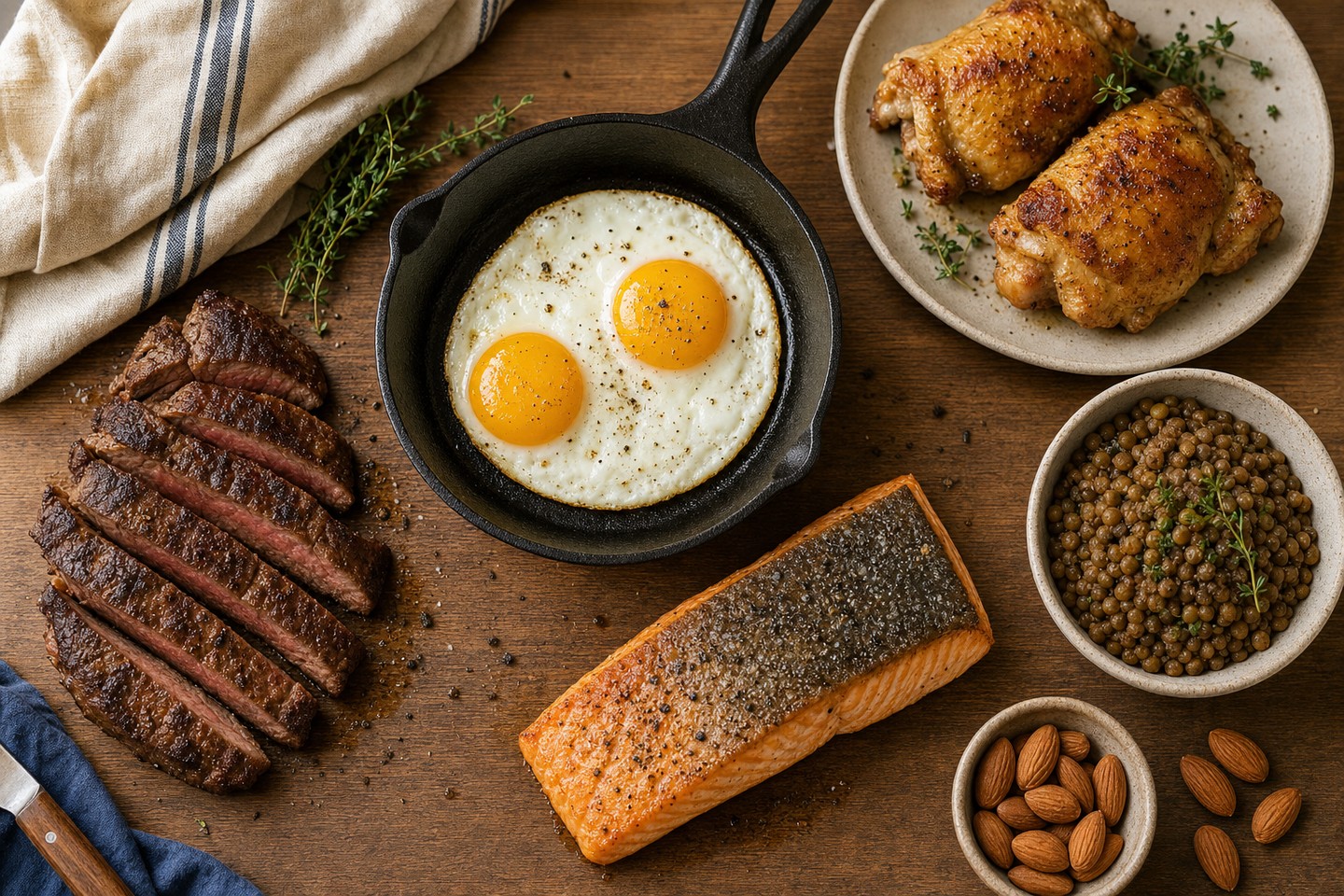
Here's the part that should be a relief: if you're already cooking whole-food meals — a real protein source, vegetables, a starch, most nights — you're very likely clearing your threshold without ever calculating a gram. That's not a coincidence. It's the actual design of a normal plate. Eggs at breakfast, chicken or fish at dinner, beans or lentils folded into a grain bowl — put together a few of these across a day and the math works itself out, the same way it always did before "macros" was a household word.
This is the whole thesis of Tasty but Whole applied to one specific number instead of the general philosophy: you don't need a tracking app to eat well. You need real food, prepared with some intention, most of the time. The recipes in the book aren't built around a protein target — they're built around a plate that's satisfying, uses good ingredients, and happens to clear the threshold as a side effect of being a complete meal. That's the point. The system works without the spreadsheet.
Pick your number, then stop watching it
So: get enough protein. That part isn't in dispute, and if you're training hard, aging, or actively building muscle, "enough" is a genuinely higher number than the old advice implied, and the newer nutrition guidance reflects that.
But don't make it the goal. Protein is good — it can't be the main event. The evidence for hitting a real, personalized threshold is solid. The evidence for stacking more on top of an already-adequate diet, in the exact processed form the food industry is happy to sell you, is a lot thinner than the marketing suggests, and it comes with real, if usually modest, costs.
Pick the number that's actually yours. Hit it with food you'd eat even if nobody was counting. Then redirect all that attention — the label-reading, the app-logging, the second-guessing at the grocery store — toward literally anything else. Sleep. Movement. A meal you actually enjoyed eating. Whole food that you enjoy will get you further than a macro ever will, because it was never really about the macro in the first place.
Sign off, Adam & Kiana