The moment the name earned its "but"
The kitchen story is easier to tell than the philosophy story, so we'll start there.
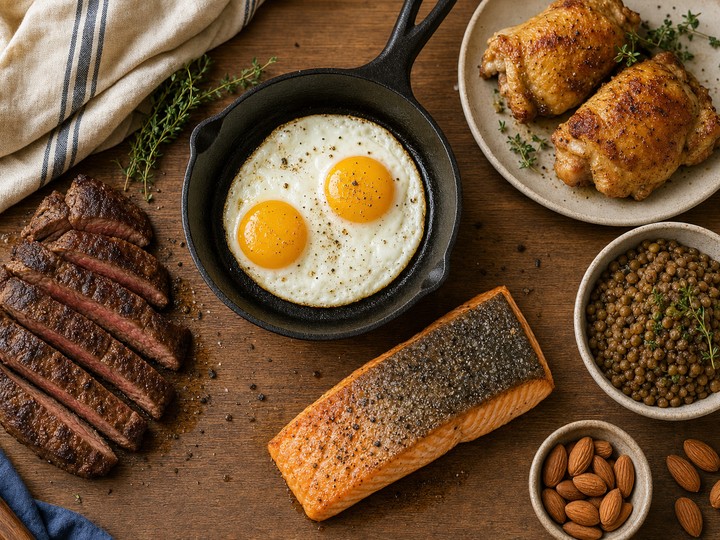
Early on, when we were figuring out how we wanted to eat, I was the one ready to compromise. I was deep into obstacle course racing at the time — training hard, competing harder, and stubborn about the numbers on race day. My instinct was to prioritize whole and let tasty absorb whatever hits it needed to absorb. Cut anything that felt suspect. If it meant a plate of dry chicken and steamed broccoli every night, that was the price of being honest about what my body needed to keep showing up on the course.
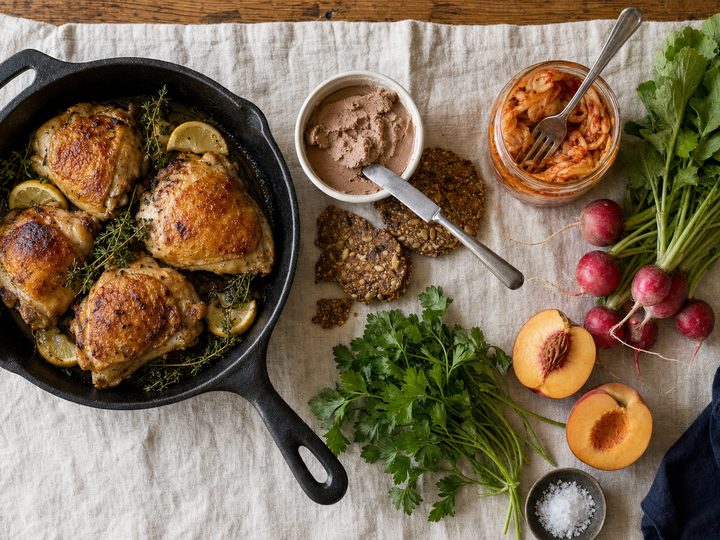
Kiana wouldn't have it. She's the chef in the family — the creative one, the one who actually knows what a plate is supposed to taste like — and she wasn't interested in eating my way to prove a point. So for a stretch, dinner was two different plates. I'd be across the table with my simple, boring compliance meal, and she'd be sitting there with something that was recognizably good food and also, quietly, doing everything I thought mine had to. She never argued with me about it. She just kept making her own food, and letting me watch it work.
Eventually I started eating more of her meals. Not all at once and not without negotiations — more protein here, a heartier carb there, a bigger portion because I was training for a race and needed the fuel. Those requested modifications are basically the reason this book exists. And the surprising part was that I didn't just feel as good on her food. I felt better. The nutrition benefits were still there. The stress of having to eat super clean wasn't. Training got easier, not harder.
That's the whole thing. She led by example, I followed with edits, and the edits became the recipes. The cookbook is her proof. The brand is what happens when you take the proof seriously and start applying it everywhere else. The name — Tasty but Whole — is the argument that came out of the kitchen and grew up.
What Tasty means
Tasty is the enjoyment. The fun. The pleasure. It's the thing most healthy-eating content treats as a sin tax — the thing you give up so you can be virtuous, or the thing you sneak in on Saturday as a "cheat day."
We think that framing is backwards. The enjoyment isn't the reward for eating well. It's the point.
If a meal isn't worth eating twice, it isn't a meal worth cooking. If a workout is so joyless you dread it, it's a workout you won't repeat. If a bedtime routine feels like a punishment, it isn't a routine — it's a resolution you'll break by February. Enjoyment is what makes any of this sustainable. Without it, you're just white-knuckling your own life, and the research on how well that works over a lifetime is not encouraging.
This isn't a new idea. Aristotle argued that pleasure isn't opposed to the good life — it's a signal that a life well-lived is being lived. His word for the goal of a human life, eudaimonia, is usually translated "flourishing." Not "willpower." Not "abstention." Flourishing. A life where the enjoyment and the rightness of the thing are pointing in the same direction, not fighting each other.
That's Tasty. Not indulgence. Not permission. The evidence that the design is working.
What Whole means
Whole is where most people get us wrong, so this is the part that needs the most work.
Whole is not a diet. It's not paleo, it's not vegan, it's not clean-eating, it's not any of the branded regimens that use "whole" as marketing. Those are all methods — sometimes useful ones, we've borrowed from several of them — but the method is not the thing. Whole is the stance the methods are trying to approximate.
Whole means being honest about what we are. We are not machines that run on macros. We are not spreadsheets that optimize for one metric while ignoring the others. Nature — us included — is made of interconnected, interacting complex systems, and each of those systems has its own integrity. So does the greater system they're all part of. That integrity is fractal: what's true at the smallest scale is true at the largest, and the health of the whole depends on the health of each part.
What you eat affects how you sleep. How you sleep affects how you train. How you train affects what your body wants to eat. How you show up at the table affects who your family becomes at it. None of this is metaphor. It's physiology. The loop is real, it's bidirectional, and no supplement stack short-circuits it. You participate in the loop or you don't.
Whole means participating on purpose.
The evidence that "whole" is not just a vibe
We're a food-and-life brand, not a scientific journal, but this is a Study note and it's worth naming the receipts.
A 2024 umbrella review in the BMJ pooled the population data on ultra-processed food across roughly 9.9 million people. The headline: convincing evidence linking heavy ultra-processed food consumption to higher rates of cardiovascular death, type 2 diabetes, and common mental disorders. Not a subtle signal — a loud one, across millions of lives.
That could still be a correlation story if the mechanism didn't check out. It does. A randomized controlled trial from Kevin Hall's team at the NIH housed adults for a month and fed them two diets — ultra-processed and minimally-processed — matched for calories, macros, sugar, sodium, and fiber. Participants ate as much as they wanted and rated both diets equally tasty. On the ultra-processed diet they ate about 500 more calories a day and gained weight; on the whole-food diet they lost it. Same reported pleasure, different biology.
The word people usually miss when they read work like this is ultra-processed. Not "processed." Yogurt is processed. Cheese is processed. A frozen fillet of wild sockeye is processed. Ultra-processed means foods built mostly from ingredients you'd never find in a home kitchen — hydrogenated oils, high-fructose corn syrup, emulsifiers, flavor systems, protein isolates — engineered to be hyper-palatable and shelf-stable. That's the category the signal is coming from.
None of this is a claim that ultra-processed food is poison, or that every packaged item is a betrayal of your body. Dose matters. Context matters. A protein bar on a long ride is not a moral failure. But when you put the epidemiology and the mechanism next to each other, "eat mostly whole food" stops being an aesthetic preference and starts being what a fair reading of the evidence recommends.
The Further Reading section has the full studies if you want them, plus the ones on sleep and training that back the "everything's connected" claim above.
Why "but"
The word does a lot of work in the name, and it does it on purpose.
Most people, when they hear healthy cookbook, assume the deal on offer is: give up the fun, get the health. Give up the flavor, get the virtue. Give up dessert, get the abs. The "but" is our argument with that assumption. Yes, we care about whole. But — not and — we refuse to give up tasty in exchange. The "but" is there to name the fight, not to smooth it over.
The other choice most healthy-eating content offers is the mirror image: give up the health, get the fun. Eat what you want, life is short, moderation is a moral panic. That's the hedonism corner. It has the same fatal flaw as the ascetic corner — it picks one side of a tension that shouldn't be a tension at all.
We are not in either corner. Tasty but Whole is the argument that the whole thing is a false choice. That maximum tasty and maximum whole are not endpoints of the same slider. That the interesting work is not picking a side but designing a way of eating, moving, resting, and living that refuses to.
Aristotle called this the mean — the virtuous state that sits between two failure modes, not as a limp compromise but as the difficult, skillful position that requires more of you than either extreme. Courage is the mean between recklessness and cowardice; both extremes fail. The healthy life, in his frame, is the mean between austerity and self-indulgence — and neither pole is virtuous. Both are ways of not doing the harder thing.
The harder thing is holding both.
The rooms of the house
The cookbook is the food-shaped manifestation of the philosophy. It's the front door because food is where most people meet us. But the philosophy doesn't stop at the plate, so the site doesn't either. There are seven rooms, and each of them is the same argument applied somewhere else.
The Kitchen is where technique earns the plate. Whole ingredients, real cooking, refinements that make a recipe worth repeating. Whole applied to how food gets made — the boring, unglamorous, deeply enjoyable craft of not phoning it in.
The Pantry is where we're honest about what we buy and what we don't. Real receipts, not affiliate copy. Whole applied to sourcing — the slow work of not being lied to by a label, and of knowing which industrial shortcuts we're okay with (frozen wild salmon, canned tomatoes) and which we're not (seed-oil-fried anything, flavor systems pretending to be food).
The Family Table is where all of this survives contact with actual life. A toddler who ate broccoli yesterday and stages a coup today. A newborn on your hip while dinner is fifteen minutes from ready. Guests. Mixed diets. Whole applied to feeding a family without shrinking the world for anyone at the table.
The Study is the room you're in right now. The ideas behind the food, the brand, and the life. This room exists because the philosophy is the thing, and the recipes are the evidence. If a note doesn't fit anywhere else and it's saying something true, it lives here.
The Nightstand is sleep, breath, and the wind-down that makes tomorrow repeatable. Not a wellness section — the actual practices that hold a hard week together. Whole applied to rest, and to the honest admission that most of what we call "productivity" is actually a proxy for how well we slept the night before.
The Gym is training, strength, endurance, recovery. What we lift, run, ride, and fuel around. The proof that whole isn't fragile — it's what makes you durable at 34, 44, 54, 64. Whole applied to what your body can do, and to the loop that connects the plate to the sled to the sleep to the plate.
The Outdoors is what happens when the kitchen goes camping. Trail food, race food, the emergency burrito after a long ride, the packing list for a mountain weekend with a baby. Whole applied to the parts of life that don't fit indoors — and, for us, the reason we bother eating well in the first place.
None of these is a lifestyle vertical bolted onto a cookbook. They are the same argument, told in seven rooms. If you find yourself agreeing with the philosophy in one room and disagreeing with it in another, either we haven't written the note yet that would have convinced you or the philosophy has a hole we haven't found. Both are useful outcomes for us.
The boring answer to how it works
People ask, sometimes, how we manage to hold both sides — how we don't drift into asceticism when we're being disciplined, or into hedonism when we're being generous with ourselves. The honest answer is boring and practical.
Real ingredients. Real cooking. Real movement. Real rest. Real presence with the people who actually live in our house.
Every one of those words is doing work. Real, as opposed to the industrial substitute. Ingredients, as opposed to products. Cooking, as opposed to assembly. Movement, as opposed to punishment. Rest, as opposed to collapse. Presence, as opposed to attendance.
There's no protocol. There's no rulebook we hand out. There is a set of principles that lets us reason about the tradeoffs in front of us, meal by meal and day by day, so that the choices we make add up to a life we recognize. When a decision is hard, the tiebreaker is usually the same: which choice serves both tasty and whole, even if it takes a little more effort? Almost always, that choice exists. When it doesn't — and sometimes it doesn't — we pick whole for the everyday and tasty for the occasion, and neither one apologizes to the other.
What this note is for
If you found us through a recipe, or an Instagram post, or a friend handing you a book, this is the map of the territory the rest of it comes from. The recipes are the entry point. The philosophy is why they're worth the trouble. The seven rooms are how the same idea shows up in the rest of a life.
If any of it lands, read the ones that speak to you. Skip the ones that don't. Push back on the ones you think we got wrong — we'd rather sharpen the argument than protect it.
Kiana was right, by the way. It really is possible to have both. I still hit my race goals. I just stopped white-knuckling the way there. The rest of what we write is our best attempt to prove she was right about more than just dinner.
— Adam & Kiana
P.S. — a note on the peach.
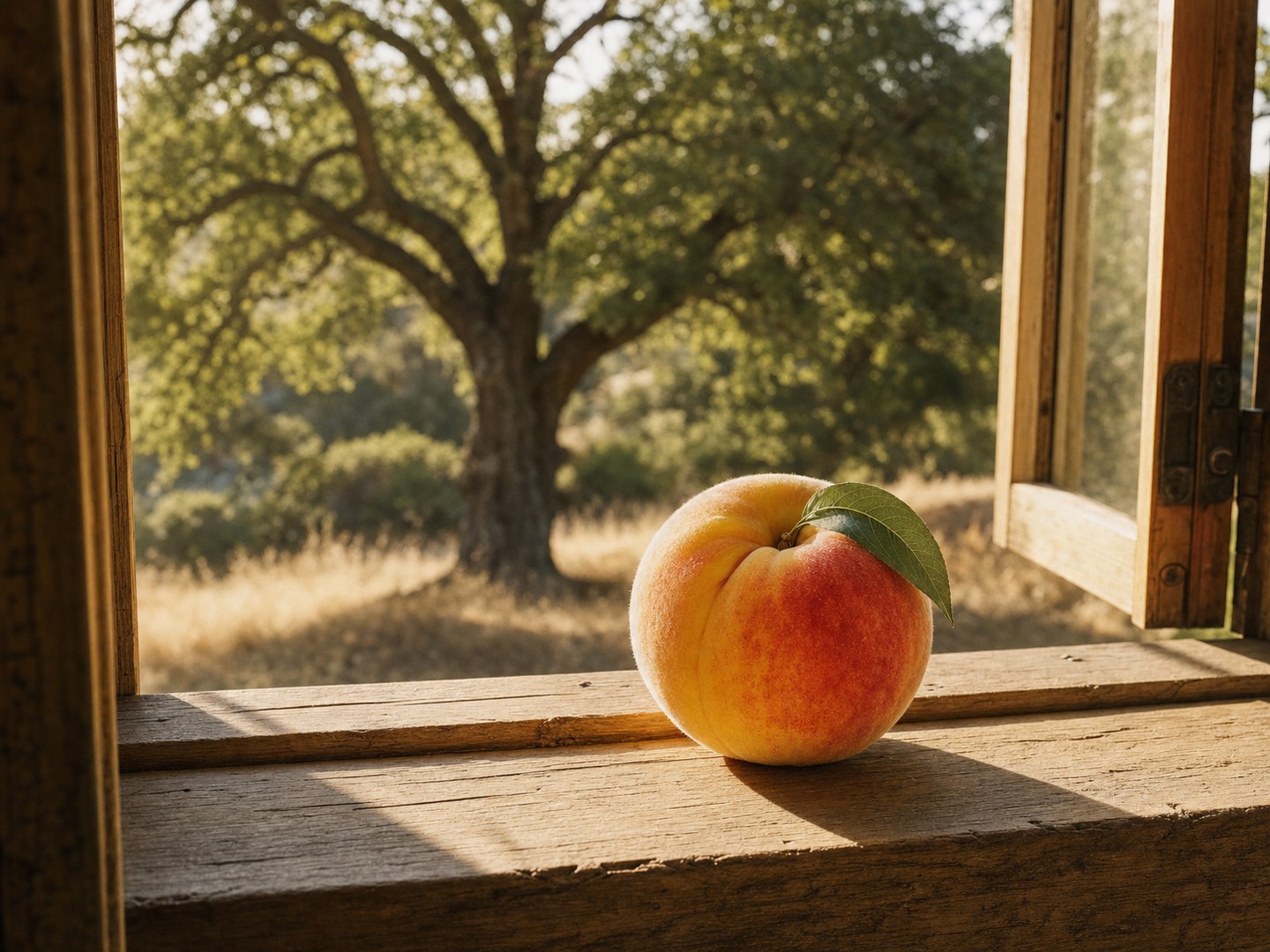
If you've spent any time on the site or the socials, you've seen the peach. It's not decoration.
A peach is the exact thing this note is about. It's obviously tasty — sweetness, acid, aroma, the kind of ripe that runs down your wrist. And it's obviously whole — skin, flesh, fiber, pit, all of it working together, all of it there because a peach tree spent a season making it that way. You don't eat around the good parts. You don't strip it down to isolate one nutrient. You eat the peach.
It's also honest about imperfection. A ripe peach has soft spots. It bruises. It won't survive being packed for shipping the way a hard, flavorless one will. Real food that's actually good tends to work like that — better on the plate, less convenient on the shelf. The trade is worth it.
And a peach doesn't try to be anything else. It doesn't need to be marketed as clean, superfood, or optimized. It's just a peach, and a peach is enough. That's the argument in fruit form.
So when you see the peach on this site, on the book, on Instagram — that's what it means. Tasty, whole, honest, and enough on its own.
P.P.S. — a note on the name.
If you read the name out loud fast, you might hear a second joke in it. We hear it too. That was not an accident. A brand that takes itself entirely seriously is a brand that has forgotten the audience is human. Ours are humans, and some of them are five, and some of them are dads, and both of those groups are funnier than the wellness industry would like.
So: yes, we heard it. Yes, we kept it. No, we are not going to explain it.
— Adam & Kiana