Can 60 minutes a week really be enough?
Yes—if you pick the right 60 minutes.
It will not turn you into a powerlifter or erase every other health decision. It can build and preserve meaningful strength without letting training consume the rest of your life.
This Note is a template, not a prescription. Adam runs one version. Kiana runs another. There are many versions that work. The job is to cover a few big movements, make them gradually harder, and keep coming back.
The standard is not destruction. The standard is usefulness. If lifting makes you too sore to pick up a kid, cook dinner, hike, work, or train again, the session was too expensive.
What the science says—and what it does not
Evidence-based: resistance training works at lower doses than fitness culture often implies. Research on minimum effective volume from Brad Schoenfeld and colleagues suggests beginners can make meaningful strength and hypertrophy gains with roughly four hard sets per muscle group per week; returns tend to diminish as weekly volume moves above roughly 10–20 sets. The exact number is not magic. Training history, effort, exercise selection, sleep, and recovery all change the answer. But “I need six days in the gym for this to count” is not supported by the basic point of that research.
The American College of Sports Medicine sets a sensible mainstream floor: train two or more non-consecutive days and cover the major muscle groups. Its familiar beginner guidance—roughly 8–10 movements and 8–12 reps—fits a fuller gym session, but the principle holds: train big patterns consistently, use manageable loads, and progress.
Strength is a health-span issue, not just appearance or performance. Research finds grip strength useful as a predictor of later health outcomes, and age-related loss of muscle mass and function is real. Estimates often put muscle loss after 30 around 3–8% per decade, becoming more consequential later. You cannot out-cardio a weak body at 65. Aerobic capacity matters; so does standing up, carrying things, catching yourself, and handling load.
Clinical common sense: learn movements with control, use ranges of motion you can own, and leave some reps in reserve. A plan that fits your recovery and your actual week is safer and more durable than a perfect plan that turns into a guilt object by Thursday. Two non-consecutive sessions make that recovery math easier for most people.
Lived experience: Adam’s rule is simple: “Never be so sore that you can’t lift or it affects your life outside the gym.” That is not a randomized controlled trial. It is a useful operating rule for a person who wants to keep training through work, family, travel, and the ordinary mess of a real week.
The honest reframe is this: 60 minutes at meaningful intensity beats five hours of aimless gym-wandering. For most non-lifters, program design is not the bottleneck. Showing up is.
The framework: squat, hinge, push, pull
Four movement patterns cover a lot of the human movement map:
- Squat: knee-dominant lower-body work—sitting down and standing back up under control.
- Hinge: hip-dominant lower-body work — the movement pattern of picking a heavy thing up off the ground without hurting yourself, and, separately, the movement pattern of squatting behind a bush on a long hike. Both matter. Only one is in this program.
- Push: upper-body pressing, both horizontal and vertical.
- Pull: upper-body pulling, both horizontal and vertical.
Any program that covers all four twice a week gives you a real strength stimulus. Programs that skip one—usually pull—can leave you with the imbalanced body of someone who did bro-splits in high school.
This is a template not prescription. Your version depends on your equipment, experience, body, injury history, and preferences. The pattern matters more than the branded exercise. Keep the map; choose roads you can use.
Four movements, four equipment paths
| Movement | Barbell | Dumbbell | Kettlebell | Bodyweight |
|---|---|---|---|---|
| Squat | Back squat, front squat | Goblet squat, Bulgarian split squat | Goblet squat, double-KB front squat | Bodyweight squat, pistol squat progression |
| Hinge | Deadlift, Romanian deadlift | Single-leg RDL, DB RDL | KB swing, KB deadlift | Single-leg glute bridge, Nordic hamstring curl |
| Push | Bench press, overhead press | DB bench, DB overhead press | KB floor press, KB overhead press | Push-up variations, dip (parallettes/rings), pike push-up |
| Pull | Barbell row, weighted pull-up | DB row, DB pullover | KB row, KB high-pull | Pull-up (band-assisted → negatives → strict), inverted row, ring row |
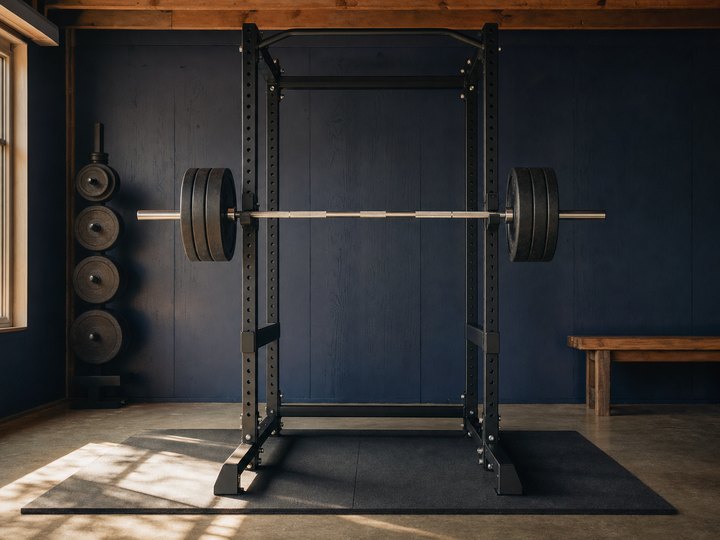
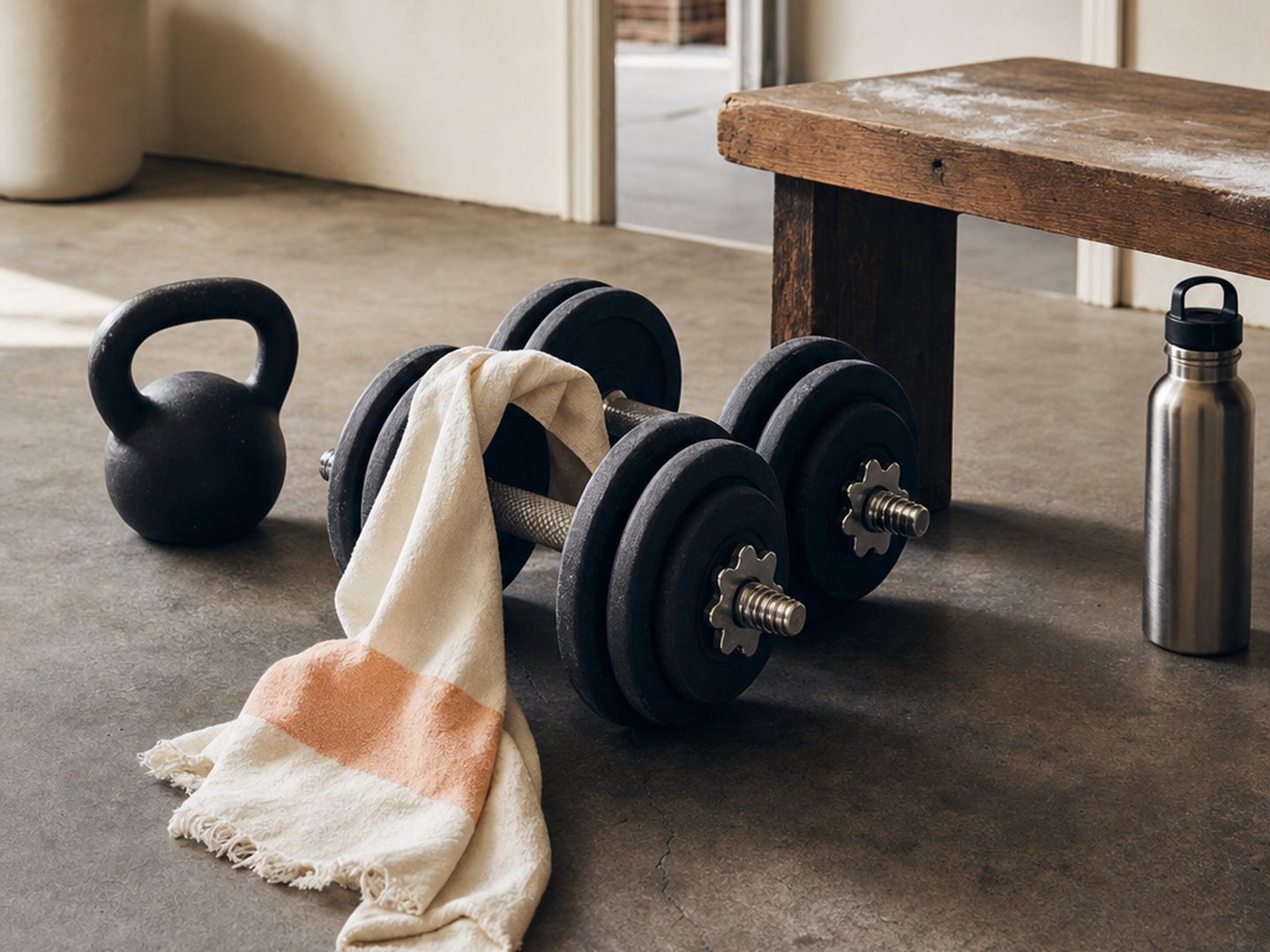
With gym access or a full home setup, a barbell is the most efficient path for adding load. Dumbbells cover all four patterns well. One kettlebell is especially good for hinge work because of the swing and still covers the other three. With nothing, use bodyweight and progress through single-limb variations, tempo, range of motion, or leverage.
Traditional mode is the core
Traditional strength training—moderate reps, rest between sets, and progressively heavier loads—is the highest-signal path for strength. The research on strength and hypertrophy is clearest here. HIIT is a legitimate time- or preference-driven alternative, not a requirement.
“Here’s how one person—me—runs the traditional MVP. Yours will look different. That’s the point.”
Adam’s loadout is kettlebell goblet squat, kettlebell swing, weighted dips, and weighted pull-ups. The belt is a progression tool, not an entry requirement; bodyweight is plenty while dips or pull-ups are hard.
Warm up each movement with a light bodyweight or lighter-weight version. It is a quick ramp into loaded movement, not a separate workout.
For the work sets, use 8–12 reps per lift and stop at about 80% of failure, never full failure. In plain English: finish with a couple clean reps still available. That is not sandbagging. It is enough effort to drive adaptation without turning technique desperate or recovery expensive.
Rest about 60 seconds, by feel; start the next set when ready. Adam walks around the garage gym rather than sitting down. Those pauses can be mobility: move through full ranges of motion, not an aggressive stretching project.
Start light and progress. Add load when you can do it with control. When it starts to feel too heavy, plateau for a bit or back off, then build again from a lighter weight. A productive session takes 30–40 minutes, not an evening.
HIIT mode is the alternative, not the punishment
HIIT is useful when the whole session must fit inside 20 minutes, when straight sets bore you into skipping training, or when you want a cardio-strength blend. It does both jobs imperfectly but efficiently. Keep loads lighter than in traditional work: bodyweight-only for pull-ups and dips, and a lighter kettlebell for swings and goblet squats.
EMOM (every minute on the minute) is Adam’s preference. Assign a movement or pair to each minute, do the reps, and rest for whatever time remains. His two-minute rotation is:
- Minute 1: 10 kettlebell swings + 5 pull-ups
- Minute 2: 10 kettlebell goblet squats + 5 dips
Repeat until you cannot complete the reps with correct form in the allotted minute. That qualifier matters. The stopper is not merely missing a rep count; when form breaks, the set is done. Track completed minutes and let that number rise slowly over time.
40/20 intervals (Tabata-style) are Kiana’s preference: work for 40 seconds, rest for 20, and cycle through the movements. There is no fixed rep target. Do quality reps for the full work period. It is time-boxed, simple, and good for someone who does not want to think about numbers mid-session.
AMRAP (as many rounds as possible) sets a total window—10, 15, or 20 minutes—and a small circuit, such as five swings, five push-ups, five rows, and five squats. Move through clean rounds and record the total. The score is rounds completed, not how wrecked you feel.
Fixed circuits use a chosen movement order for a set number of rounds, with a small rest between rounds. They are predictable and easy to progress by adding a round or a rep per round.
Traditional work wins when maximum strength is the goal, when you are new to lifting and should not learn form under fatigue, or when recovery bandwidth is thin because of young kids or high work stress. Whichever HIIT structure you choose, form is the stopper. When it breaks, the set is done.
Cardio is the compound stack
Walk as much as possible. Then add two or three zone-2 cardio sessions a week, 30 minutes or longer. Walking is the baseline, every day; zone 2 is the structured layer.
Cardio is not a competing priority here. Concurrent-training research does find some interference when high-volume endurance work and heavy strength work compete for the same recovery resources. At MVP volume—two strength sessions plus two or three zone-2 sessions—that interference is minimal for most people, while the cardiovascular benefits support recovery and capacity. Cardio does not compete with strength at this dose. It compounds with it.
Put the sessions wherever they fit. A plan that survives the week is better than a color-coded calendar that collapses when work runs late.
Other minimalist programs worth knowing
Simple & Sinister (Pavel Tsatsouline / StrongFirst) is an almost-daily kettlebell practice of swings and Turkish get-ups for generalized strength, work capacity, and injury resistance. Its advantages: one kettlebell, lots of practice, and a strong coaching community. Its tradeoffs: no explicit pull work, a narrow movement library, and commitment to the Pavel/StrongFirst methodology.
StrongLifts 5×5 uses squat, bench press, deadlift, overhead press, and barbell row—typically five sets of five, three days a week, adding load frequently. It is simple, proven, and can build real beginner strength while covering all four patterns. It needs a barbell, rack, and plates; linear progression stalls within months; and three days exceeds a 60-minutes-a-week reader’s commitment.
The MVP, by contrast, is flexible on equipment and structure: traditional or HIIT, only two sessions a week, and compatible with the rest of your life. If Simple & Sinister means “master a small toolbox” and StrongLifts means “build a real barbell base,” the MVP means “cover the movement map, stay strong enough for life, and do not let training eat the rest of the day.”
Substitutions, progression, and the next level
You do not have to do pull-ups. Any pulling exercise will do. Adam’s order for building toward one is: negatives (jump up and lower slowly), banded pull-ups, then ring rows or inverted rows. Begin with the version you can control. A clean negative or consistent row beats a wild full pull-up.
The progression rule is equally plain: add weight or add a rep. Whichever moves the number. If you cannot move it, deload—reduce the weight or volume—and begin progressing again. Never lift to full failure. Never get sore enough that life outside the gym pays for it.
Graduate from the MVP after a six-week plateau despite consistent effort, when pursuing a 300-pound deadlift, competition, or focused physique change, or when you simply want to lift more. The MVP is a floor, not a ceiling. Then real programming beats a minimum-viable framework: consider StrongLifts, Starting Strength, 5/3/1, Simple & Sinister, or a coach.
Strong enough for life
The MVP is not strength maximization. It is strength that stays available when life gets loud.
It is the physical foundation of Tasty but Whole™: cooking a real dinner after a long day, hiking with a toddler on your back, picking up a kid from the floor for the tenth time in an hour, taking a full load in after a trip to the grocery store. That is what strong enough looks like at 30, 40, 50, or 70.
Tasty and whole is not just about what is on the plate. It is about the body that shows up to the plate. Sixty minutes a week, done well, can keep that body available for a long time.
For further reading
- ACSM’s Guidelines for Exercise Testing and Prescription — Evidence-based exercise-prescription reference for readers who want the mainstream floor.
- Science and Development of Muscle Hypertrophy — Brad Schoenfeld’s research-grounded guide to muscle-growth training variables.
- Kettlebell Simple & Sinister — Pavel Tsatsouline’s focused swings-and-get-ups alternative to this broader template.
- StrongLifts 5×5 — Free beginner barbell guide for readers ready to train three days a week.