Three months before the Spartan Race Trifecta World Championship, I deleted every strength workout I had except this one.
It was 2022. I was working a 60-hour week, I had just started a master's program, and I had a plane ticket to Sparta, Greece. Something had to go. What went was all of my supplemental strength training — every accessory day, every OCR-specific circuit, everything except one 45-minute barbell session I had been running for a while called He-Man.
I kept it because it was the only piece I could not replace. I added one thing to it — a dips and chin-ups superset — because dropping my dedicated grip work would have been a disaster on an obstacle course. I expected to hold serve. Instead my grip kept getting stronger on less work than I had ever done.
That block was 45 minutes a week. One session. Everything I had left went into running miles. My strength was essentially on autopilot.
I have run this program for five years. Twice a week it builds. Once a week it maintains. It has survived every busy season I have thrown at it, and it is the single piece of training I would keep if I could only keep one.
Where it came from
I ran StrongLifts 5x5 for about two years before this. It is a good program and I do not have anything bad to say about it. It has a specific failure mode, though, and it is the same one StrongLifts itself will tell you about: as the weight climbs you need three to five minutes between sets to recover, and longer rests mean a longer workout. Mine crept toward an hour and a half. I did not have an hour and a half.
The other input came from Jacques DeVore's Maximum Sustainable Power work, which I found through Primal Endurance by Mark Sisson and Brad Kearns. The prescription is ten to twenty seconds of rest between reduced-rep sets at a heavy load — lift three or four reps, rest briefly, three more, rest, two more, working down a ladder without ever really recovering. DeVore built it for cyclists, and he applies it one lift at a time.
He-Man is what happens when you run that ladder across six consecutive barbell lifts and never leave the rack. That part is mine. Nobody handed it to me and I have never seen it written down anywhere else.
The name is from Masters of the Universe, which I feel no need to defend.
The program
Six barbell lifts, one bodyweight superset, one finisher. Every work set uses the same descending ladder: 4, 3, 3, 2, 2, 1. Fifteen reps total at a weight you would normally get five, with twenty seconds of rest between sets.
The weights below are an example, not a prescription. They are one specific loading — the men's standard, explained further down — shown so you can see the shape of a real session. Your numbers will be different, and on your first day they should be much lighter. Read the structure, not the plates.
| Lift | Warmup | Work sets |
|---|---|---|
| Barbell Lunge | 5 x 135 - 3 x 155 | 4,3,3,2,2,1 x 185 |
| Barbell Overhead Press | 5 x 95 - 3 x 115 | 4,3,3,2,2,1 x 135 |
| Barbell Back Squat | 5 x 185 - 3 x 205 | 4,3,3,2,2,1 x 225 |
| Barbell Bench Press | 5 x 135 - 3 x 155 | 4,3,3,2,2,1 x 205 |
| Barbell Bent Over Row | 5 x 135 - 3 x 155 | 4,3,3,2,2,1 x 185 |
| Barbell Deadlift | 5 x 185 - 3 x 205 | 4,3,3,2,2,1 x 245 |
| Dips & Chin-Ups (superset) | 5 x BW | 6,4,4,2,1 x BW + 25 |
| Finisher: Barbell Burpees | - | 10 x 135 |
Rest is twenty seconds between work sets. That number is the program. Warmup rest is about forty seconds, and rest between exercises is whatever you need — but be honest with yourself, because those two flexible numbers are exactly where a 45-minute workout quietly becomes a 70-minute one.
The order is not arbitrary. The bar's starting position moves down through the session — off the rack at standing height, then down to the bench, then down to the floor. You are never resetting the pins upward mid-workout, and you are never fully stripping and rebuilding the bar to get to the next lift. It only goes down.
This matters more than it sounds like it should. At twenty seconds of rest, the transition between lifts is not dead time you can spend however you like — it is most of the workout's actual friction. Every pin you move and every plate you pull is time the clock is still running. Descending order means each changeover is one adjustment in one direction, and it collapses the fussing to almost nothing.
I am deliberately not giving you hole numbers. Rack geometry varies, and so does the height of the person using it — the exact pin positions are something you will work out in about two sessions and then never think about again. The rule is the thing to keep: design the session around your rack, and only ever go down.
The last compound lift is a Deadlift, not an RDL. Bar goes all the way to the ground, knees bend. I hold the bar the whole way through and start from the top, which is why I mislabeled it as an RDL for longer than I would like to admit, but the movement pattern is a full deadlift and you should treat it as one.
No dip bars? Push-ups work. Double the reps — your first set becomes 12 push-ups paired with 6 chin-ups. I load the superset with a dip belt; a weighted vest does the same job.
The final set of every exercise is as many as possible. The prescribed rep count is a minimum, not a target.
Make it your own
The barbell is what worked for me. It is not the point.
The point is the movement pattern and the rep scheme. What the session actually asks for, in order, is:
- A lunge
- An overhead press
- A squat
- A horizontal press
- A row
- A hinge
- An upper-body push/pull superset
- A full-body finisher
All of it run at your five-rep-max weight for the prescribed reps.
If you do not have a barbell, or you do not yet have the strength or the technique for one of these lifts, swap it for something that trains the same pattern. Dumbbells, kettlebells, a trap bar, a leg press, machines, bands, rings — any of it is fair. A goblet squat is still a squat. A single-arm dumbbell row is still a row. A hip hinge on a trap bar is still a hinge.
I have had success with the barbell version over five years, and that is the version I can speak to honestly. But this program is a structure, not scripture. Build your version, run it, and tell me how it went — hello@tastybutwhole.com. I read every one.
Start so light it feels stupid
This is the instruction people ignore, and the one they regret later. It is also where the real work of the early weeks happens — good form sets in, and your body gets used to the routine.
Pick weights that let you finish the entire workout in under 30 minutes — roughly three and a half minutes per lift and for the superset, plus three for the burpees. It should feel light. It should feel fast. You should walk out of the first three or four sessions with no soreness at all, faintly embarrassed, wondering whether you did anything.
That is correct, and there is a reason for it. Muscle adapts to load in a matter of weeks. Tendons and connective tissue take months to years, because collagen turns over slowly and blood supply is poor — which makes fast load increases one of the most reliable ways to hurt yourself. The hard part of this program is never the weight. It is the density. Let the density be the thing that makes you uncomfortable first.
Two phases, and the second one is the engine
There are only two ways to get stronger on any program: move heavier weight, or move the same weight with less room to hide. He-Man does the first until it stalls, then switches to the second.
Strength phase. Add 5 lbs per session to each lift — 10 is fine on the deadlift — but never more than 10 lbs added to any single lift in a session. Rest is flexible here. Keep going until one of three things happens:
- You reach your goal weight in every lift. Freeze everything and move to the Power phase. Congratulations.
- You reach it in some lifts but not others. Stop adding weight in the ones that arrived, keep climbing in the rest.
- The workout crosses an hour and twenty. Your goals are too high right now. Drop each lift down to the nearest rung on the ladder and move to the Power phase anyway.
Power phase. Weights are frozen. Now the clock is the load. Warmup rest to 40 seconds, work-set rest to 20, unlimited rest between lifts. The goal is completion without form failure — take extra time between exercises if you need it.
When you can finish without any extra rest between work sets, cut work-set rest to 15 seconds. Repeat. Then to 10 seconds. Repeat. Then, if you have not already, bring the whole thing under 40 minutes to own the level — close the gaps between lifts and move faster inside them until it happens.
From there you either set new goals and return to the Strength phase, or you chase Mastery, the optional third phase — the same level, completed under 30 minutes, attempted no more than once a week. You get there by rebalancing reps across the ladder to cut the number of rest periods, by shaving rest, and by lifting more explosively. Every other session that week gets run slow and clean, because chasing a time twice a week is how people get hurt.
The one rule
A rep with imperfect form does not count, and it ends that exercise for the day. After three failures, deload that lift by roughly 10%.
I took the principle from Primal Blueprint Fitness, where the basis of lifting heavy things is completing high-intensity reps with good form, and you stop a set once it has reached its real end. Sisson's version ends the whole workout. I have always found that extreme for this context. Ending the specific exercise, though — that I believe in completely.
Here is the mechanical reason. On heavy compound barbell work, when form goes, you start loading ligaments, tendons and muscles in ways they were never meant to be loaded. You overuse one thing, over-stretch another, compress a third. The entire point of training is to build your body up. The moment you are doing damage instead, the math has flipped and you should stop. Every single time I pushed through a rep I knew was loose, I felt it the next day, and not in a good way — a back that went out, a knee that started talking, a hip that got crooked.
The rule has a second job, and honestly it might be the more important one. I am competitive. I always want more weight on the bar. And you can absolutely buy weight you have not earned by paying for it with technique. If you do that repeatedly and keep progressing on top of it, you will get seriously hurt — especially at these rest intervals, and especially with barbell burpees waiting at the end. The form rule is what stops your ego from writing checks your connective tissue has to cash.
What it is good at, and what it is not
It is not optimal for maximum strength, and I want to be honest about that. The research on rest intervals is clear, and de Salles and colleagues laid it out in 2009: at loads between 50% and 90% of 1RM, three to five minutes between sets produces more total reps and greater strength gains than short rests do. Twenty seconds is not the way to build the biggest possible squat. If a max powerlifting total is your goal, run a program built for that goal.
What twenty seconds buys is density, and density is what makes the program survivable inside a real life. Fifteen quality reps at a heavy load, six lifts deep, in 45 minutes.
It also coexists with hard endurance training unusually well, and the reason is boring: it is not very much work. The 2012 meta-analysis by Wilson and colleagues found that the interference between endurance and strength training shows up primarily when endurance sessions are frequent, long, or badly sequenced — and that the attenuation lands hardest on lower-body strength. It is a volume and scheduling problem, not a mystical one. Two 45-minute sessions leave enough room that I could run 40 to 60 miles a week and still add weight to the bar.
Hold onto that last point about the lower body. It comes back when you get to the standards below, where the leg numbers are deliberately conservative.
Why a barbell program is on a food site
Tasty but Whole™ started with a cookbook, but it was never only about cooking. The name is an argument: that you do not have to choose between food you actually want to eat and food that is actually good for you. Most people believe that trade is real, so they pick a side — they eat joyless food and resent it, or they eat well and feel guilty. The whole premise of this brand is that the trade is smaller than advertised, and that most of it disappears once you build a system you can live inside.
He-Man is the same argument applied to a barbell.
The fitness industry sells the same false choice the food industry does. Either you are serious — two-hour sessions, six days a week, a program that assumes you have no job and no kids — or you are not really training. Both options are designed for someone whose life is training. Mine is not. Yours probably is not either.
So the question I actually care about is the one this whole brand is built on: what is the least you can do and still get the real thing? Not a watered-down version. The real thing. For food, that answer turned into a cookbook. For strength, it turned into this.
Ninety minutes a week. Two sessions. Six compound lifts and a finisher. It is not the optimal strength program and I have already told you it is not. It is the one that survived a 60-hour work week, a master's program, and a World Championship block — and I got stronger during all three. An optimal program you abandon in March is worth less than a good one you are still running five years later.
There is a second connection, and it is less philosophical. This program does not work if you do not eat. Fifteen heavy reps across six lifts, twice a week, on twenty seconds of rest, is a real metabolic demand, and it lands on top of whatever else your week is doing. If you run this on coffee and good intentions, your lifts will stall, your form will go, and you will find the deload button faster than you wanted to.
What it actually asks for is unremarkable and hard to sell: enough protein, enough total food, enough carbohydrate to fuel the session, and enough sleep to absorb it. Real meals, mostly. This is the least exciting advice in fitness and it is the reason the cookbook exists. Strength is built in the gym and paid for in the kitchen.
Eat the whole thing.
Fitting it into an actual week
Twice a week builds. Once a week maintains. That is the entire scheduling model, and I have used both ends of it.
Run the two sessions with at least two days between them — Monday and Thursday, or Tuesday and Friday. You are hitting every major pattern in each session, so the whole body needs the gap. Back-to-back days will work for exactly two weeks and then stop working.
If you are also running or riding seriously, put the lifting on the same day as a hard cardio session rather than on an easy day. It feels backwards, but it protects your genuinely easy days from becoming moderately hard days, and it concentrates the stress instead of smearing it across the week. Lift after the run, not before, unless the strength session is the priority that day.
When life compresses — and it will — drop to one session a week before you drop the weight. Frequency is the first thing people cut and it should be the last. One honest session a week at your working weights held my strength for months. Two half-hearted ones would not have.
Added benefit: the same workout, scored
This is a strength program first. But because every lift lives on a fixed plate ladder, the same workout doubles as a benchmark, and I have used it that way for years.
Level 0 is an empty 45 lb bar. Every half-step is the next configuration you can actually build with 45s, 25s and 10s — no fractional plates, no math at the rack.
| Lvl | lbs | Lvl | lbs | Lvl | lbs |
|---|---|---|---|---|---|
| 0 | 45 | 3.5 | 205 | 7 | 365 |
| 0.5 | 65 | 4 | 225 | 7.5 | 385 |
| 1 | 95 | 4.5 | 245 | 8 | 405 |
| 1.5 | 115 | 5 | 275 | 8.5 | 425 |
| 2 | 135 | 5.5 | 295 | 9 | 455 |
| 2.5 | 155 | 6 | 315 | 9.5 | 475 |
| 3 | 185 | 6.5 | 335 | 10 | 495 |
Every two full levels is one more 45 per side. Train in 5 lb steps; report in levels. The 5 lb increments are how you progress week to week. The levels are how you know where you are.
The whole program — the session, the phases, the plate calculator and both standards — is available as a free PDF you can print and keep on the rack. Download the He-Man Workout PDF.
The men's standard — the loads written into the workout above — is Lunge 3, Overhead Press 2, Squat 4, Bench 3.5, Row 3, Deadlift 4.5, Burpees 2, with the superset at bodyweight plus 25. Warmups sit roughly half a level to a level and a half below the work weight.
The women's standard is Lunge 2, Overhead Press 0.5, Squat 2.5, Bench 1.5, Row 1.5, Deadlift 3, Burpees 0.5, with the superset at bodyweight. Several of these are substantially lighter than the men's numbers, and that is exactly right rather than a hedge. The strength difference between men and women is not uniform across the body: women average roughly 70 to 75 percent of men's lower-body strength but only 40 to 60 percent of upper-body strength, and raw competition data shows the same shape — the median woman lifts about 54 percent of the median man on the bench but about 68 percent on the deadlift at the same bodyweight. So the lower-body lifts drop by about a level and a half, while the pressing lifts drop further. Applying one flat percentage to every lift would have made the presses impossible and the pulls too easy.
Two honest notes on that standard. The bottom of the plate ladder is coarse — the steps from 45 to 65 to 95 are big jumps in percentage terms, so a couple of the women's numbers were rounded to the nearest rung rather than landing exactly on the ratio. And the deadlift sits slightly high against the pure ratio, because there is no rung between 155 and 185 and the hinge should out-load the squat.
The leg numbers are intentionally dampened, and that is a design decision. These standards were derived from 5RM, and 5RM for legs is typically far higher than for upper body. Carrying that full proportion into a 20-second rest interval is where injuries live. So the lower-body standards sit lower than a straight 5RM conversion would put them. That is deliberate, it is conservative on purpose, and it is not a number you should feel obligated to fix.
Added benefit: the Superman version
The Superman version threads five 1km runs into the five gaps between the six compound lifts — after the lunge, the overhead press, the squat, the bench and the row. Five kilometers total, folded into a heavy barbell session. Nothing comes between the deadlift, the superset and the finisher, so you are never running immediately before barbell burpees.
This is not a strength workout and I do not run it as one. It is a fitness test, and I built it to answer a specific question: am I ready to race?
Obstacle course racing is a constant switch between running and a strength obstacle, and that switching is the actual skill. 5K is the sweet spot — long enough that you cannot simply redline the whole thing and have to genuinely pace it, short enough that it can still get spicy and you can push real paces. Breaking it into one-kilometer segments is the entire point: you are forced to flip between an endurance effort and a heavy strength effort over and over, sending blood and energy where the next task needs it, then flipping again.
No safe route? I swap in 100 calories on an air bike per kilometer.
I think of it as the garage gym version of a Hyrox race — which is 8 x 1km alternating with eight functional stations. Mine is shorter, heavier, and free.
Strength is not the only thing that matters. Run the Superman when you want to know where your all-around fitness actually stands. Then go back to the strength program.
Who should not run this
- Anyone without solid barbell competence. Twenty-second rests are a terrible place to learn to squat. Build the movements first.
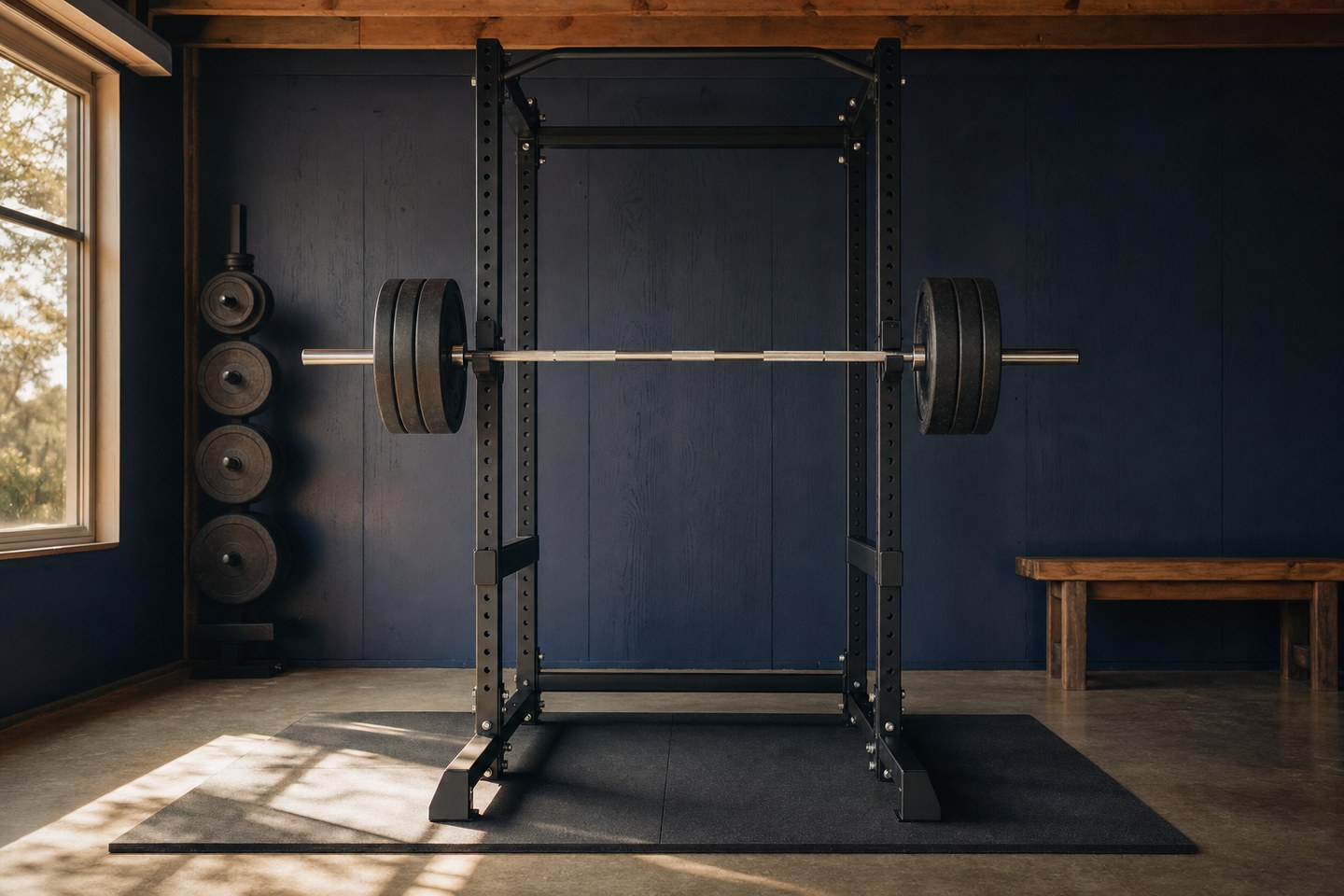
- Anyone training alone without safeties. Six heavy lifts with short rests, ending in barbell burpees. Use a rack with pins.
- Anyone coming back from injury. Rehab first, density later.
If you are starting from zero, start with The Strength MVP instead. That is the floor — 60 minutes a week, the minimum that works. He-Man is what comes after it.
— Adam