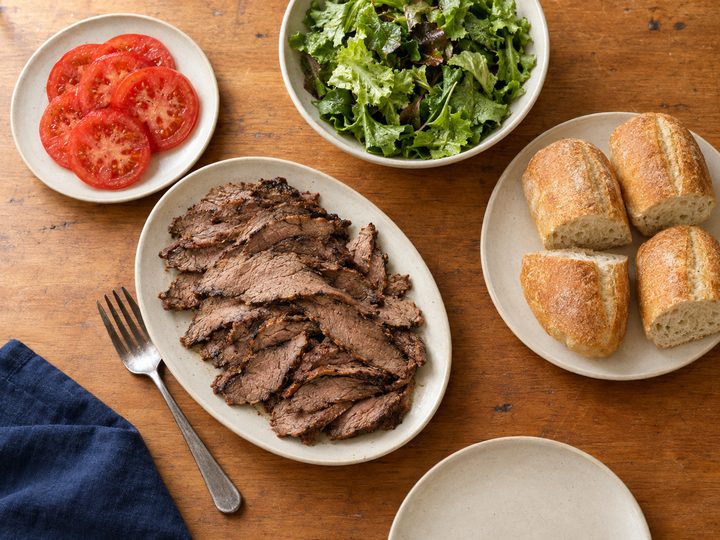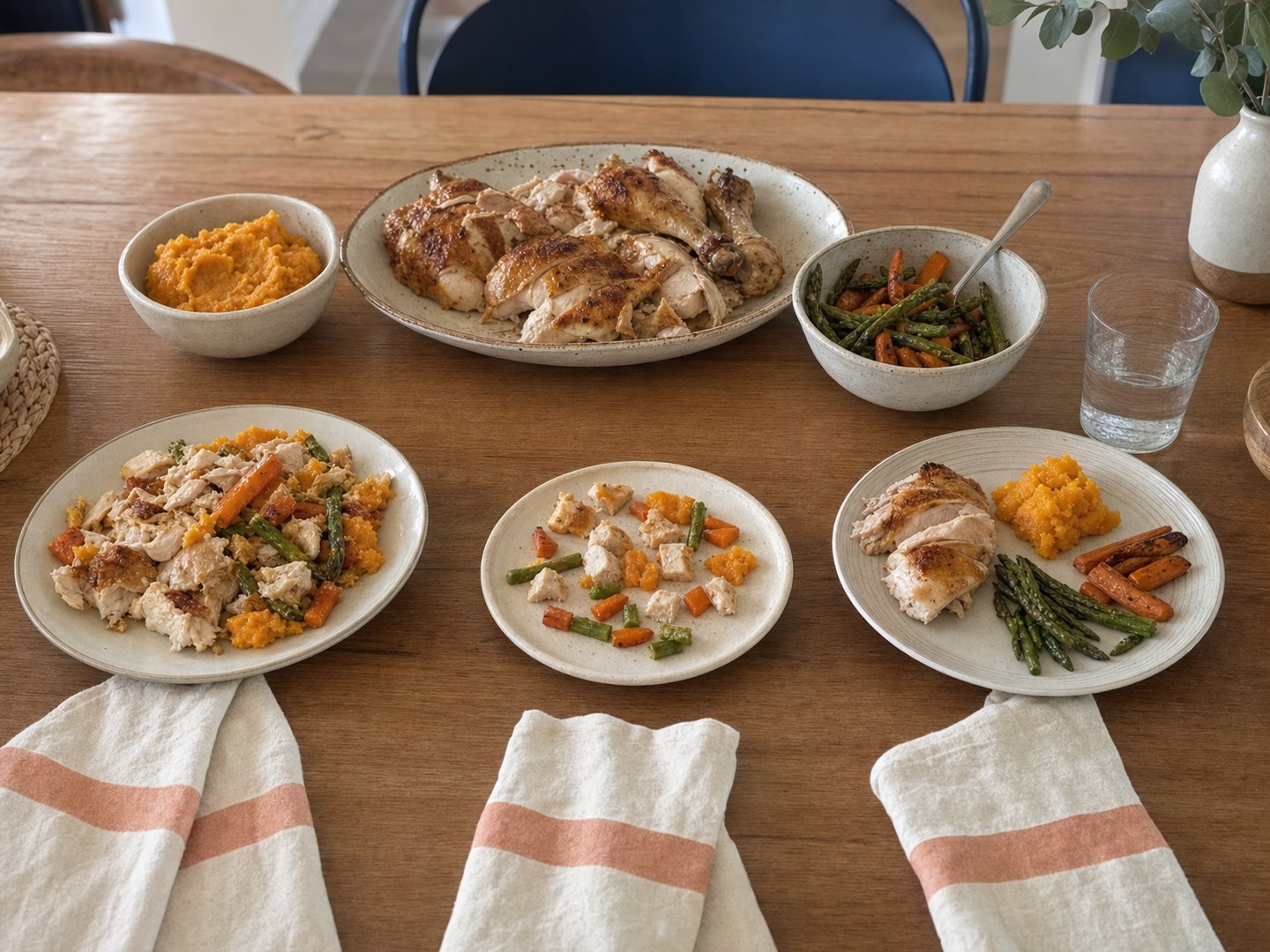
Riley is 22 months old. On a typical night, she has a stainless-steel, three-section kids’ plate suctioned to the table. There might be corn on the cob, asparagus, something cut smaller than ours, and cheese. Under the table, Waffle is on cleanup duty. If it hits the ground, it is Waffle’s.
She eats while we eat. That is the picture now. It can look effortless from the outside, but it came from a long runway of repetition, adjusting, and refusing to make dinner a test.
This is a general guide to the principle that has shaped our home: the family table is the goal; the feeding method is a tool. What worked for Riley is one example. When Mason arrives, he will have his own needs, pace, and probably opinions about avocado.
The point is not to win the baby-led weaning versus purée argument. The point is to help a kid learn that food belongs at the table with the people they love.
Why the family table matters
Shared meals are not magic or a moral scorecard. They are a reliable place to practice connection, modeling, language, and food exposure at the same time.
Decades of family-meal research from Jayne Fulkerson and colleagues at the University of Minnesota link more frequent family meals with stronger dietary patterns and social and emotional benefits for children and adolescents. The former Center on Addiction and Substance Abuse at Columbia University likewise reported associations between regular family dinners and lower adolescent risk behaviors. These are associations, not promises. But repeated, calm time together matters.
The benefit starts before a child can hold a conversation. They watch utensils, hear food names, and see that broccoli, beans, rice, and roast chicken are normal parts of a meal. They learn that meals have a rhythm and that being at the table is about more than finishing something. Beans, in particular, do the double work of nutrition and comedy. Riley will figure out the second part on her own.
Here is how we think about the evidence:
- Evidence-based: Research on family meals, including the work of Jayne Fulkerson and colleagues, consistently finds beneficial associations with diet quality, family connection, and adolescent well-being.
- Clinical common sense: Offering foods repeatedly and without pressure gives children more chances to become familiar with tastes, textures, and smells. Familiarity is not a guarantee of acceptance, but it is a better starting point than avoidance.
- Lived experience: Riley has become comfortable handling a wide range of foods because she has seen and touched them over and over, including plenty she did not eat at first.
Feeding a kid is not about optimizing a single dinner’s intake. It is about building a relationship with food that lasts 40 years, not four. The family table is where that relationship starts.
What starting solids actually looks like
Before anyone chooses a method, there is a mainstream safety and nutrition baseline. For most babies, solids begin at about six months, when they can sit with good head control, bring objects to their mouth, show real interest in food, and move food around their mouth rather than automatically pushing it back out. The American Academy of Pediatrics’ guidance on starting solid foods and the World Health Organization’s complementary-feeding guidance are useful anchors here; a pediatrician should help with an individual child’s timing.
Food in the first year complements rather than replaces breastmilk or formula. Solids are where a child begins learning flavors, textures, movement, and family rhythms.
The old idea that every baby must begin with rice cereal is gone. Current guidance emphasizes iron-rich foods: meat, beans and lentils, eggs, iron-fortified grains, and other age-appropriate sources. What matters is a varied, safely prepared diet over time.
Allergens deserve intention, not fear. Current AAP guidance supports introducing common allergens early rather than delaying them, with special attention from a clinician for babies with severe eczema, an existing food allergy, or other higher-risk circumstances. Peanut, egg, dairy, tree nuts, wheat, soy, fish, shellfish, and sesame all belong in that conversation. The LEAP research on early peanut introduction helped reverse the old “wait as long as possible” advice.
Some boundaries are straightforward: no honey before 12 months because of botulism risk; no added sugar; keep added salt very low; and change food shapes to remove choking hazards. Whole grapes, nuts, popcorn, hard raw vegetables, spoonfuls of nut butter, and coin-shaped sausage rounds are not beginner foods.
There is room for all approaches. A preloaded spoon of mashed beans, a soft strip of chicken, a smooth purée, and a family stew can all help a child become part of the meal.
The family-table principle
The family-table principle is a stance, not a method. The baby sits with the family. The baby is offered what the family is eating, adapted for safety, temperature, and developmental ability. The baby watches, touches, and learns. There is no need to build a permanent parallel food system called “kid food.”
That does not mean every meal must be identical. A child may need a softer texture, a purée alongside the meal, a deconstructed dish, or more time with a skill. The adaptation keeps the child in the meal rather than outside it.
The methods are the how. The family table is the why.
This maps cleanly onto Ellyn Satter’s Division of Responsibility in Feeding: the parent decides what, when, and where food is offered; the child decides whether to eat and how much. It is a simple division, but it changes the emotional temperature of a meal. We provide the structure. Riley gets agency inside it.
No pressure. No performance. No anger at the dinner table.
How we enacted it with Riley
We used baby-led weaning principles as a guide, following the approach popularized by Gill Rapley, but we did it intuitively rather than dogmatically. We were interested in self-feeding, family food, and letting Riley explore. We were not interested in treating any method like a religion.
From the beginning, Riley’s high chair was at the family table. The setup was basic: a bib, an easy-clean surface, and Waffle nearby. Waffle is a lived-experience footnote, not a feeding recommendation, but his cleanup service has been excellent.
Our first food was avocado. Riley hated it and still does not prefer it, which is funny only because avocado is often treated as the perfect first food. Then came steamed carrots and sweet potatoes, plus intentional allergen introductions at home. Crab cakes and peanut butter were hits. Eggs took time. Around eight months, Riley tried jalapeño and loved it.
Those reactions were data, not verdicts. A child can reject a food many times and later decide it belongs in the rotation. We kept offering.
During her first year, we kept a few household rules: no honey, no added sugar beyond what occurs naturally in fruit, and no heavily salted food for her. We generally avoided highly processed food and seed oils because that is how we prefer to eat as a family—not because those choices are a substitute for pediatric guidance. If it was not something we wanted on our own plate, we did not make it a default for hers. A whole-food diet also has downstream effects that a diaper-changing parent will notice within about 48 hours. We will leave it at that.
At one year, honey was back on the list, and we grew more flexible with naturally sweet foods and fermented foods. Texture and bite size changed with her skills, not just the calendar. We stopped cutting blueberries once she could manage them safely, while continuing to prepare higher-risk foods conservatively: grapes are still quartered lengthwise, and anything round, hard, sticky, or slippery gets another look. The goal is participation, never a deadline.
At 22 months, Riley eats what we eat, sometimes cut smaller because she does not have a knife at the table. Her favorites include bananas, peanut butter, every berry, sweet potatoes, corn on the cob, asparagus, bread, cheese, and grass-fed butter. She still hates avocado. Tough meats such as steak are practice food right now: she may chew or suck without swallowing much.
The hard nights are usually not dramatic. They are the quiet absurdity of a full plate and a toddler who wants only sweet potato, rice, or—once—edamame. We do let her have more of foods she likes so she stays nourished. But our guardrail is that she has to engage with everything on her plate before she gets more of any one thing. Engagement can mean touching it, squishing it, smelling it, bringing it to her mouth, tasting it, or spitting it out. It is not a demand for a clean bite.
Two small moves work better than speeches. Sometimes we offer the food she is avoiding from our own plates, which makes it feel special without making a second meal. And we cheers food: we clink her asparagus or toast against ours, then take a bite together. It turns “eat this” into “we are doing this.”
Kiana has led this work and is especially good at reading Riley’s needs and adapting on the fly. Adam is especially good at getting Riley to try the thing she had decided she would not touch. Neither role is food police. The job is to keep the table a good place to be. We each have our duties. Some of them are the parenting kind.
The two rules that matter most
We arrived at two rules by living them. Neither is original to us. Both echo the Division of Responsibility: parents create the structure and offer the food; children retain control over their eating.
“Feed them what you eat. Your job is to offer it. Their job is to decide what to do with it.”
That is the family-table rule in one sentence. It does not demand that a child eat every component, and it does not require a parent to cook a different dinner every night. It asks us to keep inviting them into the meal.
“Never apply pressure to the point of making it a negative experience. No anger at the dinner table.”
This one protects the first. Children feel pressure quickly. We can be consistent without making a refusal the main event. We can serve a food again tomorrow without turning tonight into a referendum on our parenting. A meal can be messy, loud, and imperfect without becoming hostile.
What we expect to change for Mason
When Mason arrives, we expect to begin with the same philosophy and a much looser grip on the tactics. Riley’s approach worked for Riley. It does not prove that Mason will want the same timing, textures, flavors, or pace.
For Mason, the constants will be the family table, the shared meal where it is safe to share it, and no anger around food. But he may need more purée runway, a slower sensory-aware introduction, or more time with textures. That would mean we listened.
Some kids have feeding challenges that are bigger than normal toddler preference: allergies, oral-motor delays, sensory differences, pain, aversions, or medical needs. They may benefit from a feeding therapist, occupational therapist, speech-language pathologist, registered dietitian, allergist, or a team. There is no prize for forcing a child through a method that is not meeting their needs.
The philosophy is the constant. The tactics are the variable. That is the humility check we want to carry into becoming parents to our second.
When to ask for help
This Note is a general guide, not a substitute for a pediatrician, a feeding therapist, or a registered dietitian when something feels genuinely wrong.
Start with a pediatrician if growth is a concern, including a flagged drop across growth percentiles or poor weight gain. Ask sooner rather than later after a choking event, with recurrent coughing or breathing concerns during meals, or if you worry food is entering the airway. Gagging can be a normal protective reflex while a child learns, but repeated respiratory symptoms or apparent airway compromise deserve professional attention.
Also ask for help with severe allergic reactions—hives, swelling, vomiting, or changes in breathing—rather than trying to manage them alone. A child who rejects food groups for more than a couple of months, whose accepted-food list is steadily shrinking (especially toward 20 or fewer foods), or whose sensory distress is escalating deserves a real conversation, not internet reassurance.
Depending on the concern, the next stop may be a pediatric feeding therapist, usually an OT or SLP, a pediatric registered dietitian, or an allergist. Getting help is not abandoning the family-table principle. It is making the table workable for the child in front of you.
If you are already stuck in kid-food mode
Do not try to fix every meal this week. Start with one.
Serve the family meal. Put one small bite of it on your child’s plate next to a safe, familiar food. Do not bargain for a bite. Do not make a speech about nutrition. Do not take the rejected food personally. Repeat the same calm move for weeks, not days.
Let them see you eat it. If play helps, cheers it. If your plate makes it more interesting, offer a taste from yours. The first win is not swallowing. It is calm contact with the food.
This is not the full treatment for selective eating; that deserves its own Note. But it is the on-ramp: one meal, one familiar food, one small exposure, no pressure.
Why this lives in our home
Feeding a kid at the family table is not a productivity move. It is one of the first places a person learns whether food is generous and connective or whether it is a battleground.
We will not get every meal right. Riley will keep changing. When Mason arrives, he will change the equation again. But the standard is clear: we want food to feel like an invitation into family life.
The family table is where that begins. Tasty but Whole™ is our home for people trying to make it the former.
For further reading
- Baby-Led Weaning by Gill Rapley and Tracey Murkett — The foundational practical guide to the self-feeding approach we used as one tool, not a rulebook.
- Solid Starts First Foods® Database — A searchable reference for age-appropriate food preparation, including choking-risk and allergen information.
- Ellyn Satter Institute — Free resources on the Division of Responsibility and the feeding relationship.
- Child of Mine: Feeding with Love and Good Sense by Ellyn Satter — A foundational, parent-friendly guide to feeding relationships.
- AAP HealthyChildren.org: Starting Solid Foods — Mainstream guidance on readiness, nutrition, and safe introduction.
- The BLISS study from the University of Otago — An overview of Baby-Led Introduction to SolidS research, including safety findings when the approach is done properly.