Riley is on the trail ahead of us, then behind us, then suddenly interested in one particular root. When she is done walking, she rides on Adam’s back. Waffle moves through the brush nearby, periodically checking that the whole group is still together. There is dappled light, a hat that keeps sliding up, and the usual negotiation about whether the next bend is worth seeing.
This is not a family manual. It is one family’s working example of a bigger idea: kids need outdoor time. The tactics are negotiable; the principle is not.
Riley has shown us one way into that idea. When Mason arrives, he may need a different route, pace, and on-ramp. Every child is different. But we want both of them to know that the outdoors is not a special reward. It is ordinary life.
Why outdoor time matters
There is no single study that makes the full case for taking kids into the woods. The case is a stack of inputs: movement, light, novelty, play, attention, and the chance to meet a manageable challenge with an adult nearby.
Angela Hanscom, a pediatric occupational therapist, has made a practical case for the sensory and motor work of outdoor free play. Uneven ground, climbing, hanging, swinging, and balancing ask a child’s vestibular system (balance and motion), proprioceptive system (where the body is in space), and core strength to do real work.
Richard Louv’s Last Child in the Woods gave a useful name to a cultural pattern: “nature-deficit disorder.” It is not a clinical diagnosis; it is a way of noticing how easily nature becomes an occasional destination instead of a familiar place.
The research tradition around risky play is useful here, too. Ellen Sandseter’s work distinguishes manageable challenge from actual danger. Progressive, supervised risk lets children test balance, speed, and judgment while adults remove hazards beyond their capacity.
One of the firmer findings is vision. Population research across Australia and East Asia has repeatedly found that more outdoor time is associated with lower odds of developing childhood myopia. The American Academy of Ophthalmology’s review describes a dose-response relationship. Modest sunlight exposure also supports vitamin D synthesis and, with diet and other factors, vitamin D status.
Here is how we hold all of that without turning a hike into a lecture:
- Evidence-based: Outdoor play brings varied motor and sensory demands; outdoor time appears protective against childhood myopia; sunlight supports vitamin D synthesis.
- Clinical common sense: Measured practice with uneven ground, novelty, and manageable risk builds more competence than protection from every challenge.
- Lived experience: Riley is calmer after a hard hike. She sleeps differently and eats with more appetite when we add the woods back in. That is an observation, not a promise.
Outdoors is not a treat. It is an input.
The philosophy: make it normal
We do not bring Riley outside because every trail is serene or because children need to become miniature endurance athletes. We bring her because kids belong outside—not exclusively, not performatively, but reliably.
The outdoors gives a child contact with discomfort, novelty, boredom, dirt, changing weather, and a world that does not rearrange itself around her preferences. Those are ordinary conditions that build tolerance. A kid gets cold, gets tired legs, waits for a snack, falls down, gets muddy, needs a bathroom that does not exist, and learns that none of those experiences ruins the day. The last one especially.
The parent’s job is to make outdoor time normal, not exceptional. It is a Tuesday, not an expedition. The kid’s job is to be a kid, which includes moving, noticing, complaining sometimes, and trying again.
That stance requires adult judgment. We are not interested in a risk-free childhood, because a child cannot learn much about balance, traction, or her own limits on a perfectly padded path. We are interested in an age-appropriate one: enough challenge to learn, enough supervision to keep a small mistake from becoming a big consequence.
What outdoors with a baby actually requires
Readiness is more useful than a calendar. “Wait until they can hold their head up reliably” tells us more than a precise month count. The goal is not to clear a milestone on schedule; it is to choose the setup that fits the child in front of us.
Before a baby has reliable head control, think short, upright, close, and weather-aware. A supportive front carrier, a calm walk, shade, and the option to turn around are plenty. Riley’s first trail was at about one month old: short, front-carried, and focused on temperature and shade. That was a choice for her, not a requirement for anyone else.
As head control becomes reliable, a family may have more room for longer front-carrier walks. When a child can sit with dependable support and the carrier’s instructions allow it, a framed back carrier can become an option. The child’s comfort and the day’s conditions matter more than the plan.
Once a child wants to walk, the pace belongs increasingly to the child. Distance usually shrinks while time expands. A root, a rock, or a puddle may become the whole outing. Good. The point is not to force adult mileage through small legs.
The safety baseline is simple and non-negotiable:
- Sun: Keep young babies out of direct sun when possible; use shade, a hat, and lightweight protective clothing. For older children, use sunscreen on exposed skin as appropriate.
- Heat: Babies and toddlers do not handle heat as well as adults. Lethargy, flushed skin, unusual quietness, or a change in behavior mean shade, fluids, and an early exit.
- Cold and wind: Layers, dry backup clothes, wind protection, and a bail plan matter. Cool or mottled extremities, shivering, weak crying, or unusual quietness are not “tough it out” signals.
- Carriers: Keep the baby upright with the face visible, nose and mouth clear, and chin off the chest. Follow the manufacturer’s instructions and use a hip-healthy seat position. The AAP’s babywearing guidance is a useful safety reference.
Loose principles leave room for a child who is heat-sensitive, motion-sensitive, or simply having an off day. A calendar cannot tell us that. Attention can.
The gear reality
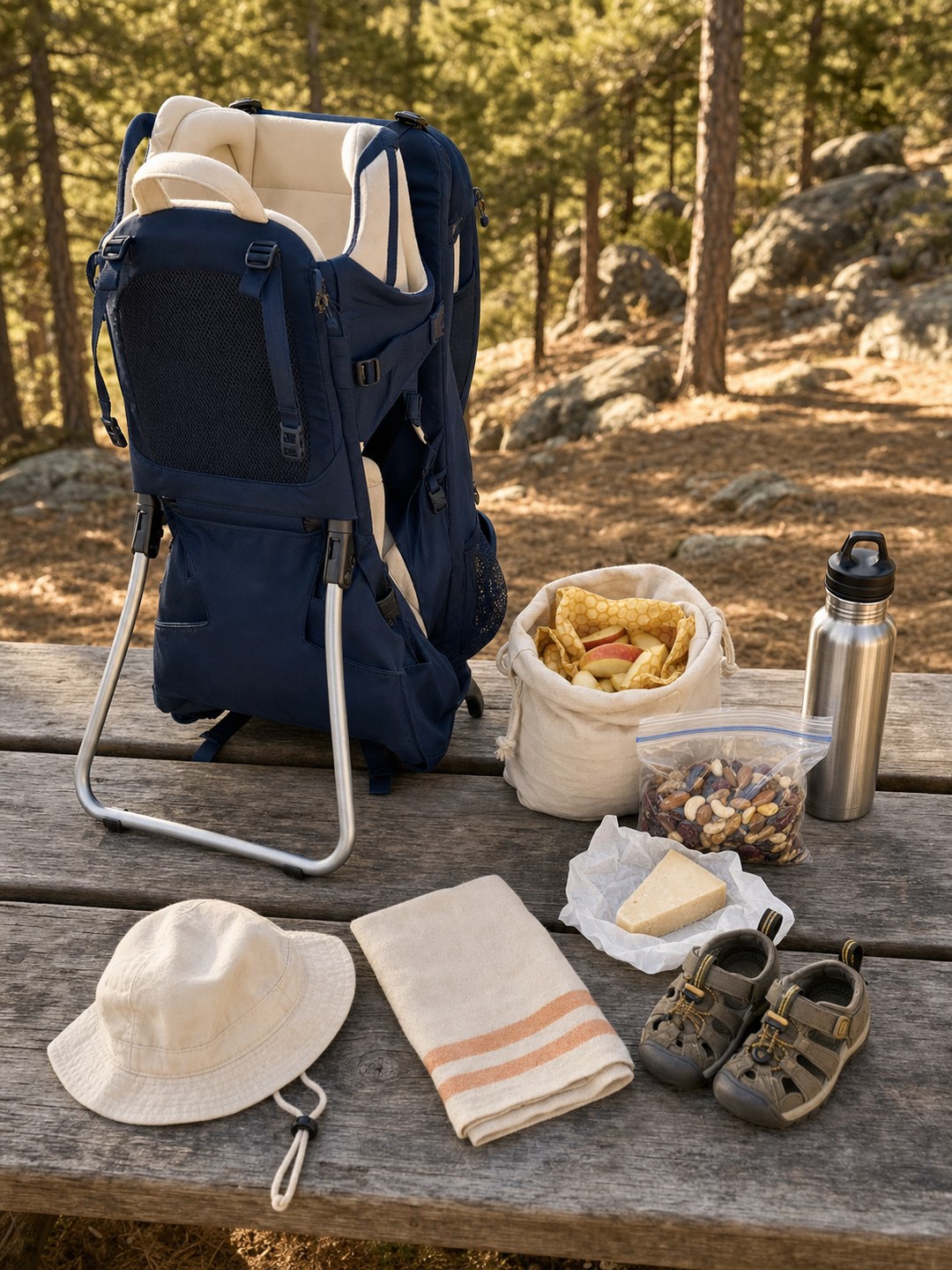
The useful gear is less glamorous than the internet makes it sound. Start with a carrier that fits both caregiver and child, then add only what solves a real problem: layers, hats, sun cover, water, snacks, diapers, wipes, and a small first-aid kit. Bring enough to stay comfortable, not enough to turn a short walk into an expedition.
Front carriers—soft-structured carriers or wraps—work well while a baby needs close support. Framed back carriers can be a workhorse once a child is ready according to the carrier maker’s instructions. An off-road stroller can be excellent on a graded path and useless on roots, rocks, or stairs. The trail determines the tool.
Our carrier of choice has been the Osprey Poco LT — a first-Christmas gift from Riley’s Ninong, and one of the most-used pieces of gear we own because of it. It is not a universal recommendation, just a data point from our family: supportive hip belt, sun shade, room for supplies, and an easy switch from “she walks” to “she rides.”
The best buying rule is restraint. Do not acquire a garage of outdoor gear before you know what your family actually repeats. The kit should grow with the habit.
How we enacted it with Riley
Our version began small: a short trail when Riley was about one month old, front carrier, shade, no objective beyond a good walk. We gradually added time, then steeper ground and longer walks. Waffle handles morale, pace-setting, and a cleanup service that operates on a whatever-hits-the-ground policy. He also produces roughly two pieces of trailside admin per outing that we handle without complaint.
The current version is more honest than the early one. There was a middle era when Riley could nap in the carrier for a long stretch and we could move for hours. Now she wants to walk. That is better for her and slower for us. We plan for a two- to three-hour ceiling because, past that, she is usually done and the whole day gets worse. A short good trail beats a long bad one.
The small mechanics matter. Water is accessible. Snacks live where we can reach them quickly. Sun cover goes up before we wish it had. We watch the weather and turn around without making it a failure.
Our best trail trick is low-tech: tractor wheels and fruit. We point out a big tire, a distinctive tree, or a stump ahead, then save fruit for the moment we reach it. Pears and bananas travel well. Peaches do not. We say this as the peach people. A peach at hour three of a hike is a laundry event. The object is not to bribe Riley into mileage. It is to help her look outward with hunger and attention.
Our roles are complementary. Adam tends to hold distance, terrain, pace, and gear in his head. Kiana is especially good at reading Riley’s state, calling it early when she is done, and keeping the mood tolerant. Waffle supplies moral support. None of this is a rigid division; it is simply how our attention tends to distribute.
The central rule has been the same from day one:
“Hurt is OK. Injury is not.”
A minor knee knock, a bee sting, tears on a climb, or tired legs can be part of learning. A fall from too high, a heat emergency, a real hypothermia risk, or unsafe water is where adult judgment should have stepped in sooner. The line is not “no risk.” The line is “no preventable injury.”
Two rules for the trail
“Hurt is OK. Injury is not.”
This protects the child’s chance to learn. We can let Riley wobble, struggle, and recover without confusing every hard moment with harm.
“The trail teaches that hard is not the same as bad.”
This protects the parent from overcorrecting. A steep step, a cold hand, a delayed snack, a little boredom, or a small fall can be real and uncomfortable without being evidence that the outing was wrong. The adult keeps the boundary between productive discomfort and danger; the child gets the confidence of making it through.
Both rules are useful far beyond the woods.
What we expect to change for Mason
When Mason arrives, we expect to carry the philosophy forward with a much looser grip on the tactics. Riley’s on-ramp worked for Riley. It does not prove Mason will have the same tolerance for heat, cold, motion, noise, carriers, long walks, or being held still while the adults keep moving.
Some babies settle in a carrier; some want to move. Some are ready for longer trail days early; some need a much longer runway. For Mason, listening to those signals will not mean we failed to be consistent. It will mean we were paying attention.
For a while, we will probably be a two-carrier family: Adam with the heavier back carrier, Kiana with a front carrier for the newborn. Trip planning will change. Distances will shrink for a season. The margin for forgotten snacks will get smaller. We are fine with that.
The philosophy is the constant. The tactics are the variable. Outdoor time remains an input, not a treat. The rule remains hurt is OK, injury is not. But the route to those things belongs to the child we actually have, not the child we imagined from Riley’s story.
When to call it off—and when to worry
Turning around is a skill, not a defeat. A toddler who becomes suddenly quiet, clingy, glassy-eyed, unusually fussy, or uninterested in food and water may be telling us the outing is over. Listen early.
Leave immediately for concerning heat signs: lethargy, flushed skin, unusual quietness, behavior change, or dehydration. Get into shade, cool down, offer fluids when safe, and seek medical advice when symptoms are significant or do not improve. Treat cold with the same seriousness: get out of the wind, remove wet clothing, add dry warm layers, and act on persistent shivering, mottled or cool skin, weak crying, or unusual sleepiness.
After a fall or head impact, seek urgent medical guidance for loss of consciousness, repeated vomiting, unusual sleepiness, worsening symptoms, or persistent inconsolability. Know the local hazards. Carry basic first aid and prescribed emergency medication when relevant.
A Note like this is a general guide. It is not a substitute for a pediatrician, a wilderness first-aid class, or the good sense to turn around.
The smallest possible on-ramp
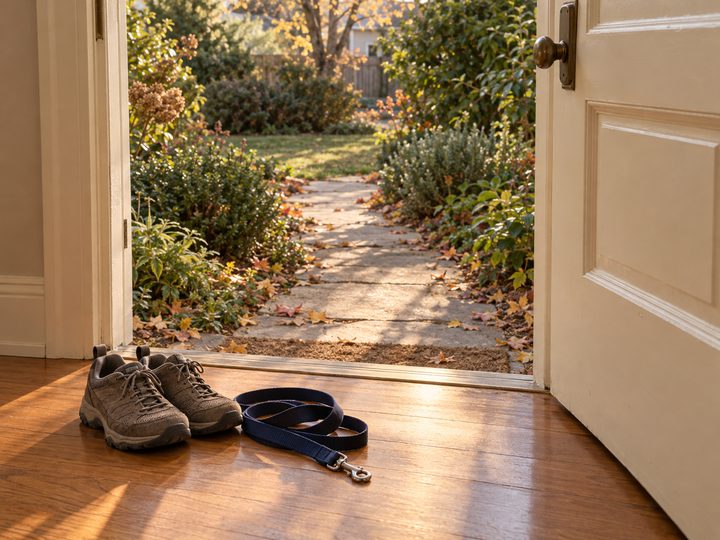
If your family has not started, do not begin with a major purchase or a long route. Begin with 20 minutes. Pick the same easy path at the same time of day twice a week. Bring water, a snack, layers, and a low bar.
Build to an hour before you build to a new trail. Bring the dog if you have one. Bring a friend if you do not. Go home while the experience is still good enough to repeat.
The first month is about the habit, not the mileage. Kids take their cues from us. If outdoors is always a reward or a once-a-month production, they will learn that. If it is normal—walk, notice, snack, come home—they will learn that, too.
Why this lives in our home
The family table and the family trail are two versions of the same project. Both are places where small rituals become a life. Both teach a child whether the world is generous, interesting, and worth meeting.
We will not make every hike good. Riley will keep changing. When Mason arrives, he will change the equation again. The direction is clear: make room for real food, real movement, real weather, and the ordinary practice of being together outside.
Tasty but Whole™ is our home for families choosing the first version.
Actionable takeaway: Put one short outdoor outing on the calendar this week. Bring water, a snack, layers, and a low bar. Leave while everyone still has enough goodwill to do it again.
For further reading
- Balanced and Barefoot by Angela Hanscom — A pediatric occupational therapist’s practical case for unstructured outdoor play and sensorimotor development.
- Last Child in the Woods by Richard Louv — The foundational cultural framing behind “nature-deficit disorder.”
- Hike it Baby — A family-outdoors community that helps parents hike with young children.
- REI Expert Advice: Hiking with Infants, Toddlers & Kids — Practical guidance on gear, pacing, weather, food, and planning.
- 1000 Hours Outside — A cultural movement and trackable challenge for families who want to spend more time outside.
- Ellen Sandseter’s researcher profile — A starting point for her body of work on children’s risky play.