Most home cooks own three knives. They only need one — and it is almost certainly dull.
That sounds like a small problem until you notice what a dull knife does to dinner. It turns an onion into a chore. It makes tomatoes collapse. It makes you reach for pre-cut vegetables, then takeout, because the first ten minutes of cooking feel like work.
A sharp knife is not a chef flex. It is a friction-reduction tool. Fix it once, build a small habit around it, and you cook faster for the next decade.
Start with the paper test
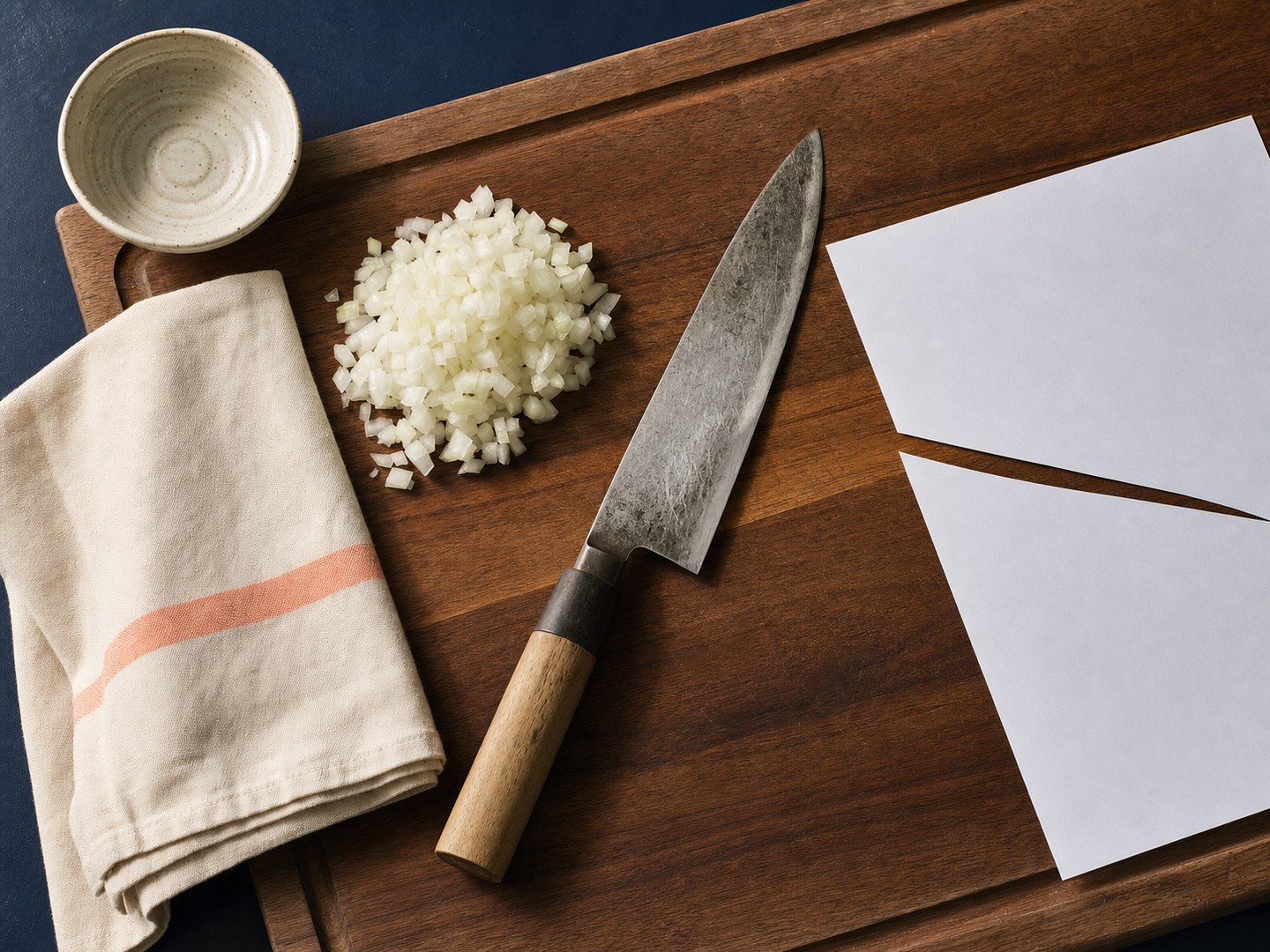
Take a sheet of printer paper. Fold it in half. Hold the top edge and try to slice straight down through it in one clean motion.
A sharp knife glides. A dull knife grabs, tears, or forces you to saw.
That is your baseline. No guessing. No pretending the knife is “probably fine.” If it fails the paper test, it needs attention.
There is a safety point here too: a dull knife asks for more force. More force means less control when the blade skips. The goal is not to make your setup fancy. The goal is to make the basic tool predictable.
The one-knife philosophy
A good 8-inch chef’s knife does about 95 percent of normal home cooking.
It handles onions, herbs, carrots, cabbage, chicken, squash, and the pile of vegetables that makes a weeknight meal feel like a meal. For the remaining five percent, keep a small paring knife around for garlic, strawberries, and other small work.
That is enough.
The five-piece knife block is a marketing win. It sells the idea that every ingredient needs its own specialist. In practice, it gives you a drawer full of mediocre blades and one chef’s knife you avoid because it has never been maintained.
A dull knife is like a dull anything — it works harder to do the same job and makes a bigger mess.
If you have a decent 8-inch chef’s knife already, start there. Do not replace it just because a new setup sounds fun. If you do need one, shop by feel and price tier, not by a story about forged steel:
- A $60 workhorse is enough for almost anyone who cooks regularly.
- A $100 upgrade should feel balanced in your hand and hold an edge well.
- A $150 forever-knife is reasonable if you will maintain it and use it for years.
Japanese or German? A short answer.
Most decent 8-inch chef’s knives fall into one of two broad traditions, and they cook a little differently. Not better or worse. Different.
German-style knives tend to be heavier, thicker at the spine, and ground at a wider edge angle (often around 20 degrees per side). They are durable, forgiving of hard use, and comfortable if you like the feel of a substantial tool in your hand. They power through dense vegetables and bone-in work well. The tradeoff: they take a little more effort to keep truly sharp, because there is more metal at the edge.
Japanese-style knives are usually lighter, thinner, and ground at a steeper edge angle (often around 15 degrees per side). They are made from harder steel that holds a fine edge longer and rewards good technique. They excel at clean, precise cuts. The tradeoff: harder steel is more brittle, so they do not love bones, frozen food, or being knocked around. They need slightly more care.
We use Japanese-style knives at home. They came from our wedding registry (thank you, Nala). We like the lightness, the way they behave with vegetables, and the discipline they demand — you cannot cut a frozen chicken thigh with them, and that is a feature, not a bug.
Either tradition is a good answer. Pick the one whose feel matches the way you cook, then commit to maintaining it.
We are not going to recommend a brand. The right knife is the one that feels secure in your hand, not the one with the most dramatic product description. Hold the handle. Check that your knuckles have room against the board. Make sure the blade does not feel tip-heavy or awkward. Then stop shopping.
Honing is not sharpening
This is the confusion that keeps knives dull.
Honing realigns the very thin edge of a knife that has bent slightly with use. It is fast. It removes little to no metal. You do it every few uses.
Sharpening removes a small amount of metal to create a new edge. It is what you need when the paper test fails. For a typical home cook, that is often every three to six months.
A honing rod cannot rescue a truly dull knife. A sharpener cannot replace the small maintenance habit that keeps a good edge behaving well. You need both jobs covered.
If a honing rod came with your knife block, use it. If not, buy a basic one. Around $15 is plenty. Hold the rod vertically with its tip planted securely on a towel or cutting board. Place the heel of the knife near the top of the rod at a modest angle, then draw the blade down and toward you in one calm stroke. Alternate sides. Five to ten passes per side is enough.
Do it slowly at first. The goal is not speed. It is an even angle and a motion you will repeat without drama.
The 60-minute setup path
Here is the whole system. One hour now; a much easier cooking life later.
1. Pick the knife you will actually use
Use your existing 8-inch chef’s knife or buy the best sensible one in your budget. Do not buy a full set. Add a paring knife only if you do not already have one.
2. Get a honing rod
This is the low-effort maintenance tool. Put it somewhere visible, not in a back drawer. If you have to hunt for it, you will not use it before dinner.
3. Choose one sharpening route
There are three good options. The winner is the one you will actually use.
Pull-through sharpener: About a 10-minute learning curve and roughly $30. It works. It is also more aggressive on the blade over time, so it is not the most elegant long-term solution. It is still better than living with a dull knife.
Whetstone: Roughly $40, with a first-session learning curve closer to an hour. It can produce a better long-term result and gives you more control, but it requires practice. If learning a physical skill appeals to you, this is the move.
Sharpening service: Often $10–15 per knife, once or twice a year. For most people, this is the best answer. A good service plus regular honing beats an unused whetstone every time.
4. Practice once before you need it
Hone the knife on an ordinary afternoon. Run the paper test again. Learn the motion when nobody is hungry and you are not late getting food on the table.
That is the setup. You do not need a gadget drawer. You need one good blade, one rod, one sharpening plan, and a cutting board that is kind to the edge.
The habit that keeps it sharp
The maintenance rule is simple:
- Hone every few uses, either before cooking or after cleaning.
- Sharpen when the paper test fails.
- Never put the knife in the dishwasher.
- Cut on wood or plastic, never glass or stone.
The dishwasher is hard on an edge and hard on a handle. Glass and stone boards are basically sandpaper in cutting-board form. They may look clean and indestructible; that is the problem. Your knife edge is not supposed to be the sacrificial part of the system.
Also, do not leave the knife loose in a crowded drawer. A blade guard, magnetic strip, or dedicated slot prevents the edge from knocking into other utensils. Again: boring prevention, better result.
What changes when the knife works
A sharp knife will not turn you into a restaurant cook. It will do something more useful: it will lower the threshold for making dinner.
You will chop the herbs because it takes thirty seconds. You will cut the squash instead of buying the pre-cut package. You will make the salad because the vegetables do not feel like a negotiation.
That is where home cooking gets built. Not in a perfect recipe. In the small systems that make the next right thing easy.
A sharp knife makes you a better cook the way a warm-up makes you a better athlete. Not because it changes what you can do — because it changes what you will bother to do.
Actionable takeaway: Tonight, do the paper test. If your chef’s knife tears the paper, choose your sharpening route before you cook tomorrow.
For further reading
- Serious Eats’ knife-skills guides — Free, practical lessons on choosing, using, and caring for kitchen knives without turning your setup into a gear project.
- An Edge in the Kitchen by Chad Ward — A thorough home-cook guide to knives, sharpening, maintenance, and buying intelligently.
- Bernal Cutlery — A specialty knife shop with sharpening services and useful guidance for learning what your knives need.
- Burrfection on YouTube — Detailed video demonstrations of whetstone sharpening for cooks who want to practice the skill at home.