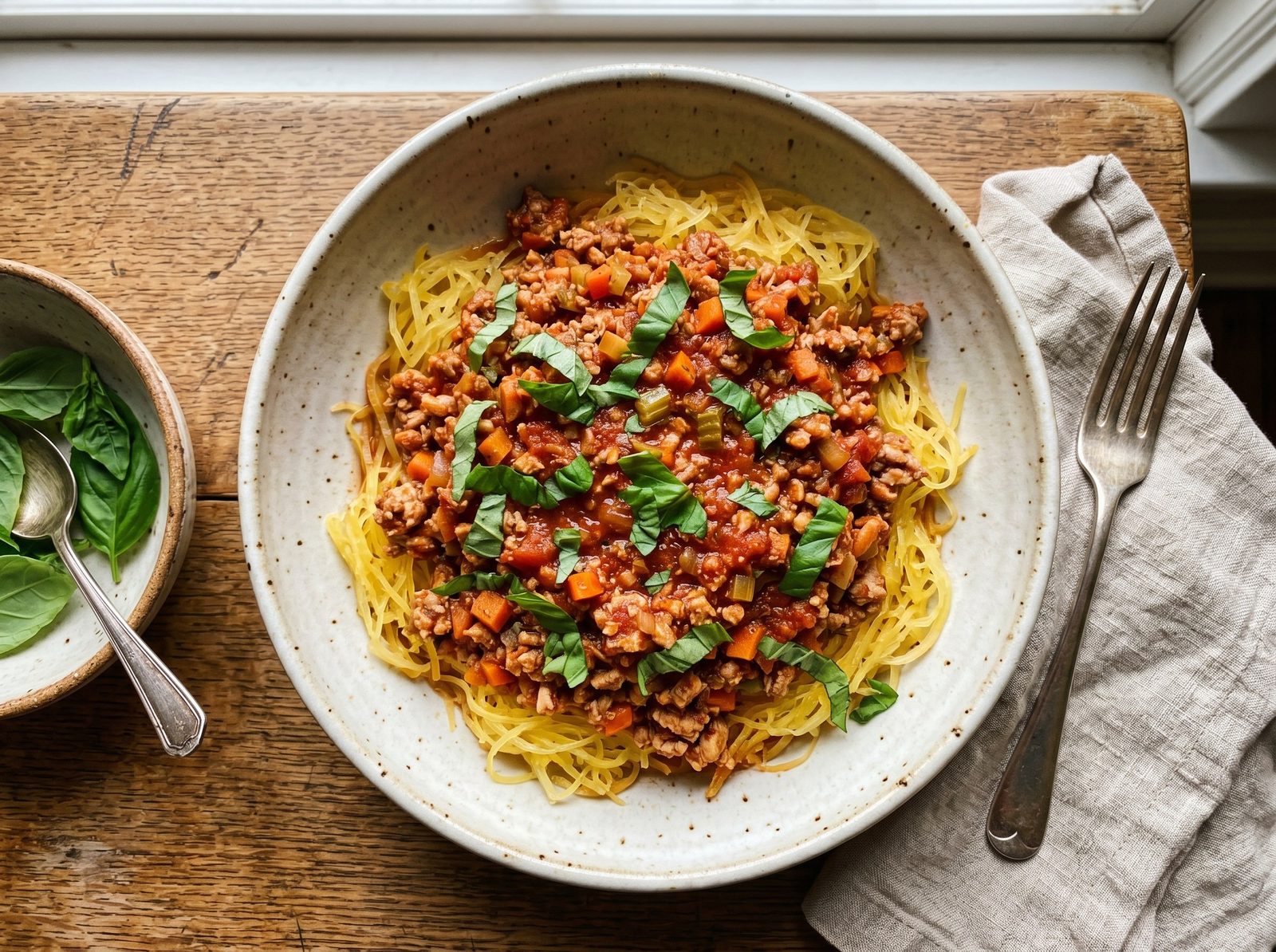
Baked Spaghetti Squash with Turkey Bolognese
This one took us a while to commit to. It's not quick. It's not "just like pasta." It's its own thing — and once we learned the trick, we stopped missing the comparison entirely. Roast the squash cut-side down with a little oil, let it get some real color, and fork the strands out while it's still warm. Suddenly it's a vehicle worth building a meal around. The turkey Bolognese here is slow-built and layered: you brown the turkey, sweat the vegetables, and let the tomato sauce reduce until it clings to everything. The result is genuinely great.
- PRO
- GF
- DF
- PF
- KID
- PREP
Calories ~370 · Protein ~28g · Carbs ~31g · Fat ~17g
Ingredients
For the spaghetti squash:
- 1 large spaghetti squash, halved lengthwise and seeds scooped out
- 1 tablespoon extra-virgin olive oil
- Salt and freshly ground black pepper
For the turkey Bolognese:
- 1 pound ground turkey
- 1 (28-ounce) can crushed tomatoes (San Marzano preferred)
- 1 medium yellow onion, finely diced
- 2 medium carrots, finely diced
- 2 stalks celery, finely diced
- 4 cloves garlic, minced
- 1 tablespoon extra-virgin olive oil
- 1 tablespoon tomato paste
- 1 teaspoon dried oregano
- 1 teaspoon dried basil
- Salt and freshly ground black pepper, to taste
- Fresh basil leaves, for serving
Method
- Preheat your oven to 400°F (200°C). Line a rimmed sheet pan with parchment paper.
- Brush the cut sides of the spaghetti squash with olive oil and season with salt and pepper. Place the halves cut-side down on the sheet pan. Roast for 35–40 minutes, until the shell gives slightly when pressed and the edges are golden, and the strands are al dente and release easily from the skin. Avoid roasting until completely soft, or the strands will be mushy.
- While the squash roasts, start the Bolognese. Heat the olive oil in a large skillet or Dutch oven over medium-high heat. Add the ground turkey and cook, breaking it into small crumbles, until browned, about 5–6 minutes. Ground turkey must reach an internal temperature of 165°F (74°C); the subsequent simmer step ensures this, but use a thermometer if in doubt. Transfer to a plate.
- In the same pan (reduce heat to medium), add the onion, carrots, and celery. Cook for 8–10 minutes, stirring occasionally, until the carrots are fully tender and the onion is deeply translucent. This is your soffritto, don't rush it.
- Add the garlic and tomato paste. Stir and cook for 1 minute until the tomato paste darkens slightly and the garlic is fragrant.
- Return the turkey to the pan. Add the crushed tomatoes, oregano, and dried basil. Stir well, bring to a simmer, then reduce heat to low and let it cook for 15–20 minutes, stirring occasionally. The sauce should thicken noticeably and coat the back of a spoon.
- When the spaghetti squash is done, let it cool for 5 minutes — just enough to handle safely. Using a fork, scrape the flesh into strands, working crosswise (across the width) for longer strands, or lengthwise for shorter, more manageable ones. You should get fluffy, noodle-like threads.
- Divide the spaghetti squash strands among bowls. Spoon the turkey Bolognese generously on top. Tear fresh basil leaves over each bowl and serve.
Variations & Notes
- Vegan Swap: Replace the ground turkey with 2 cups of finely chopped mushrooms (cremini and shiitake) and ½ cup of walnuts, pulsed until crumbly. Cook the same way — it browns beautifully and mimics meat sauce surprisingly well.
- Paleo-Friendly Adjustment: Already paleo-friendly as written. Spaghetti squash is the original paleo pasta swap.
- Extra Hungry: Serve the Bolognese over actual pasta (a whole grain spaghetti or chickpea pasta) alongside the squash. Or double the Bolognese and save half for meal prep.
- Substitutions: Ground beef, bison, or a mix of pork and turkey all work for the Bolognese. Zucchini noodles can replace the spaghetti squash if you want a faster cook: just sauté them for 2–3 minutes and expect a slightly different texture. Diced zucchini works in place of the celery.
- Storage: The Bolognese keeps for 3–4 days in the fridge and freezes for up to 3 months. Store the squash strands separately from the sauce to avoid sogginess. Reheat the sauce on the stove and the squash in a 350°F oven for 10 minutes.
# Interlude: Feeding a Big Eater Without Cooking Two Separate Dinners
One of the central problems behind this book is simple: what do you do when one person at the table needs a lot more food than the other, but nobody wants to cook two dinners?
We tried the obvious bad solution first. It was exhausting. Two proteins, two sides, double the cleanup, and a meal that somehow made everyone feel like a special-order customer in their own house.
What finally worked was much simpler: build one strong base meal, then scale intelligently. A satisfying dinner for one person can become a substantial dinner for another without turning the kitchen into a second shift.
<div class="pullquote">One dinner that still feels complete to the different people eating it.</div>
<div class="page-break-before"></div>